
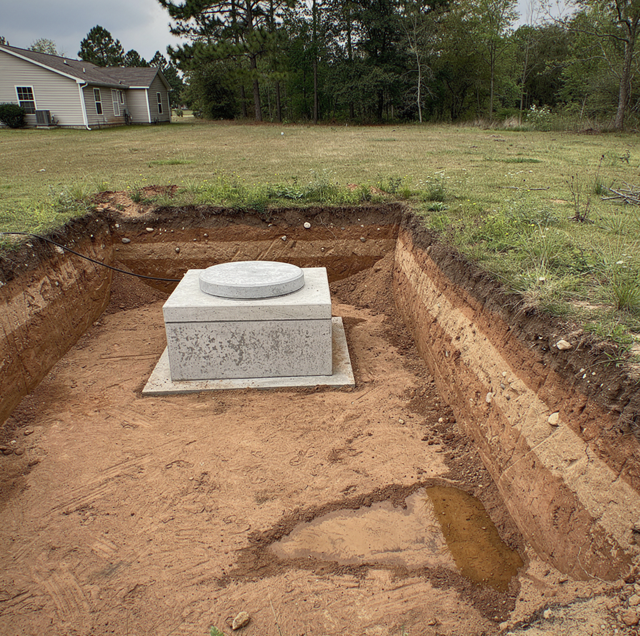
A septic system is only as good as the ground it is set in. The tank, the pipe from the house, the line out to the field, and every drain field trench sit in holes a crew digs, and the way that soil is opened, handled, and returned decides for the life of the system whether the tank bears evenly and stays level, whether the pipes hold a steady fall, and whether the trench walls still let effluent soak into the soil around them. That makes excavation during installation the first stage of the treatment system, since every part that follows works only as well as the ground beneath and around it.
Each stage of an install dig, what the digging has to get right there, and how a miss at that stage shows up later:
| Stage of the dig | What the digging has to get right | What shows up later if it goes wrong |
|---|---|---|
| Marking utilities and laying out the dig | Every buried line found and flagged, and the tank, pipe and field positions staked to the design | A cut line, or a component moved off its planned spot |
| Equipment routes across the yard | Machines kept off the future field and any reserve area | Soil that absorbs poorly from the first day of use |
| The tank hole and its base | A firm, level bed with even support under the whole tank | A tank that settles, tilts or cracks |
| Pipe runs, house to tank and tank to field | A steady downhill grade with full support along each pipe | A sag that holds water and solids |
| Drain field trenches | Level bottoms and open, unsmeared soil faces | Walls sealed by smearing or compaction that stop absorbing |
| Backfill and final grading | Soil returned in stages, rocks kept off, surface shaped to shed water | Ground over the tank that sinks and holds water |
Laying Out the Dig and Finding What Is Already Buried
Before a machine touches the yard, the dig has to be drawn on the ground. Stakes or paint marks where the tank will sit, where the house line will run to it, where the outlet line heads toward the field, and the outline of each trench. Those marks come from the system design and also show the crew where digging must stop, because every bucket outside them disturbs soil that did not need to be disturbed.
The same layout has to account for what is already underground. Utility marking comes before any excavation, so the power, gas, water and communication lines crossing the property are flagged, and the dig plan either clears them or slows to hand work where a line runs close. On a replacement, the old tank and its lines are part of this picture; finding a buried tank is its own job, and it happens before the new layout is fixed.
Utility marking covers lines the utility companies own. Private runs such as sprinkler pipe, a feed to a well pump, a gas line to a grill, or a pet-fence wire stay unmarked, so the owner's knowledge of them goes into the layout.
Paperwork belongs to this stage as well. Whether an installation requires a permit, a soil evaluation, or an inspection of the open work before it is covered is determined by the local health department or permitting authority, and, where required, the installer handles it.
Keeping Machines off the Ground That Has to Absorb
An excavator or a loaded truck presses down on every square foot it crosses. On the ground that will become the drain field, that pressure squeezes shut the pore spaces through which effluent needs to move, and the damage sits at the depth the trenches will later reach, where no surface work can loosen it. The same applies to a reserve area, if the site plan sets ground aside for a second field.
For that reason, the equipment routes get planned along with the dig itself. Routing machines along the edges of the field footprint, piling spoil off the absorption area, and digging trenches by reaching in from outside the field keep that soil open. Compaction from traffic is the same harm that wears down a working field years later; on an install, the difference is that it can be prevented before the first trench opens.
The Tank Hole and Why the Base Under the Tank Matters
A septic tank full of liquid is heavy, and it rests on whatever the excavator leaves at the bottom of the hole. The base has to be firm and level so the load spreads across the whole floor of the tank. A tank sitting on a hard point, such as a buried rock, carries its weight there; a tank sitting partly on soft or loosened soil sinks unevenly as that soil gives way. Either condition puts stress on the shell, and a concrete tank under uneven load can crack along a wall or a seam.
Level matters for a second reason. The design sets the heights of the inlet and outlet, with the inlet above the outlet, so that incoming waste drops into the tank and clarified liquid leaves from the far end. A tank set out of level moves the liquid surface relative to those fittings, so the baffles no longer sit where they were built to sit, and scum or solids can reach the outlet. Once the tank is set and covered, correcting the bed means digging the tank back out.
Pipe Runs and the Fall They Have to Keep
Two stretches of solid pipe carry the system's flow: the building sewer running from the house into the tank, and the line from the tank out toward the field. Both depend on gravity, so each has to slope downhill at a steady grade from start to finish. Too flat a grade leaves liquid moving too slowly to carry solids along. A too-steep grade on the house line lets water run ahead of the waste, leaving it stranded in the pipe.
The trench bottom is what holds that grade. A pipe needs support along its whole length, so the bottom is shaped smooth and true, and the bell ends at the joints get a small recess so the barrel of the pipe carries the load and the joint does not. Two defects undo this. A low spot, where the pipe dips and rises again, holds standing water and collects solids until the line slows or blocks. A pipe resting on a rock, or bridging a void where soil washed or fell away, carries a point load that can crack it or pull a joint apart once backfill goes on top.
Drain Field Trenches and the Soil Faces the Effluent Meets
In the drain field, the excavation shapes the treatment surface itself. Effluent leaves the distribution pipe, spreads through the trench, and moves out through the trench bottom and walls into the surrounding soil. In a conventional gravity field, level trench bottoms allow effluent to spread along the full length of each trench; a trench that falls toward one end directs flow there and loads a short stretch of soil while the rest sits idle. Where a distribution box splits the flow between trenches, its small hole needs the same firm, level base as the tank's, since a box that settles and tips sends the flow out of its lowest outlet and overloads that one trench.
The soil faces need the right condition as well as the right shape. Soil with enough moisture to crumble cuts clean, and the bucket leaves open pores on the trench walls. Soil dug while it is wet, particularly where it holds clay, smears under the bucket teeth, and the smeared face seals over the pores the effluent was meant to use. So soil moisture is a condition the crew watches on the day, and where a wall has smeared, the surface can be raked or scarified to reopen it before stone or chambers go in. The trench bottom gets the same care, since anyone walking or standing on it presses it down.
Backfill, Settling and the Final Grade
Once the tank, pipes and field components are in and any required inspection has happened, the soil goes back in stages. Around the tank and the solid pipe runs, it goes in layers, each one firmed, so the ground carries the load evenly and support builds up on all sides at once. Rocks, broken concrete, and debris stay out of the fill that touches the tank and the pipes, because a single hard object pressed against a wall or a pipe concentrates the weight of everything above it.
Loose fill settles as it takes on water and its particles shift closer together. A slight mound or crown is left over disturbed ground to allow for that, so the surface settles down to grade instead of into a hollow that collects water over the tank. The final grade then shapes the yard, so rain runs away from the tank and the field. Over the field itself, the cover soil is applied without driving across the trenches, which keeps the absorption soil open beneath the new surface.
Open excavations can collapse without warning, and an open septic tank holds gases that can overcome someone, so nobody climbs into a trench or leans into or enters a tank. Only the crew works those edges; children and pets stay clear.
After the work is covered, the new field and the ground around a newly set tank are off limits to vehicles and heavy loads, and digging near the tank, the lines, or any marked utility is left to the crew.
Frequently Asked Questions
The old tank is pumped empty first. It is then either dug out and hauled away or, where the permitting authority allows it, left in place with the lid broken in or the top collapsed and the shell filled with sand, gravel or soil. A buried empty tank left unfilled can cave in under a person or a mower years later.
Not quite. A plastic tank flexes under side pressure, so on some models the tank is filled with water as the backfill rises around it, keeping the pressure inside and outside the walls in balance.
The layer keeps backfill soil from sifting down into the spaces between the stones. Without it, fine soil washes into the aggregate over time, filling the voids that hold effluent as it soaks away. Geotextile fabric serves this purpose, and some designs call for untreated building paper or straw instead.
The hole is dug past the problem layer, and the bottom is brought back up with a bedding material such as sand or fine gravel, then leveled. That replaces a hard point or a soft spot with a uniform layer the tank can bear on evenly.
A laser level set up at the site throws a reference plane, and a receiver on a grade rod reads the height of the trench bottom or the pipe at points along the run. Comparing those readings against the planned grade shows any low spot while the trench is still open.
A new tank and the stone or chambers in the field take up space that soil used to fill, so an install ends with surplus. Part of it goes into the crown over the disturbed ground, and the rest is spread elsewhere on the property or hauled off; none of it belongs on the new field.
Contract septic system installation, including the groundwork — the tank bed, the pipe runs, the drain field trenches, and the backfill and final grade. Heavy Duty Pumping & Septic LLC serves Lucedale, Leakesville, Hurley, MS. Call (601) 804-2230.