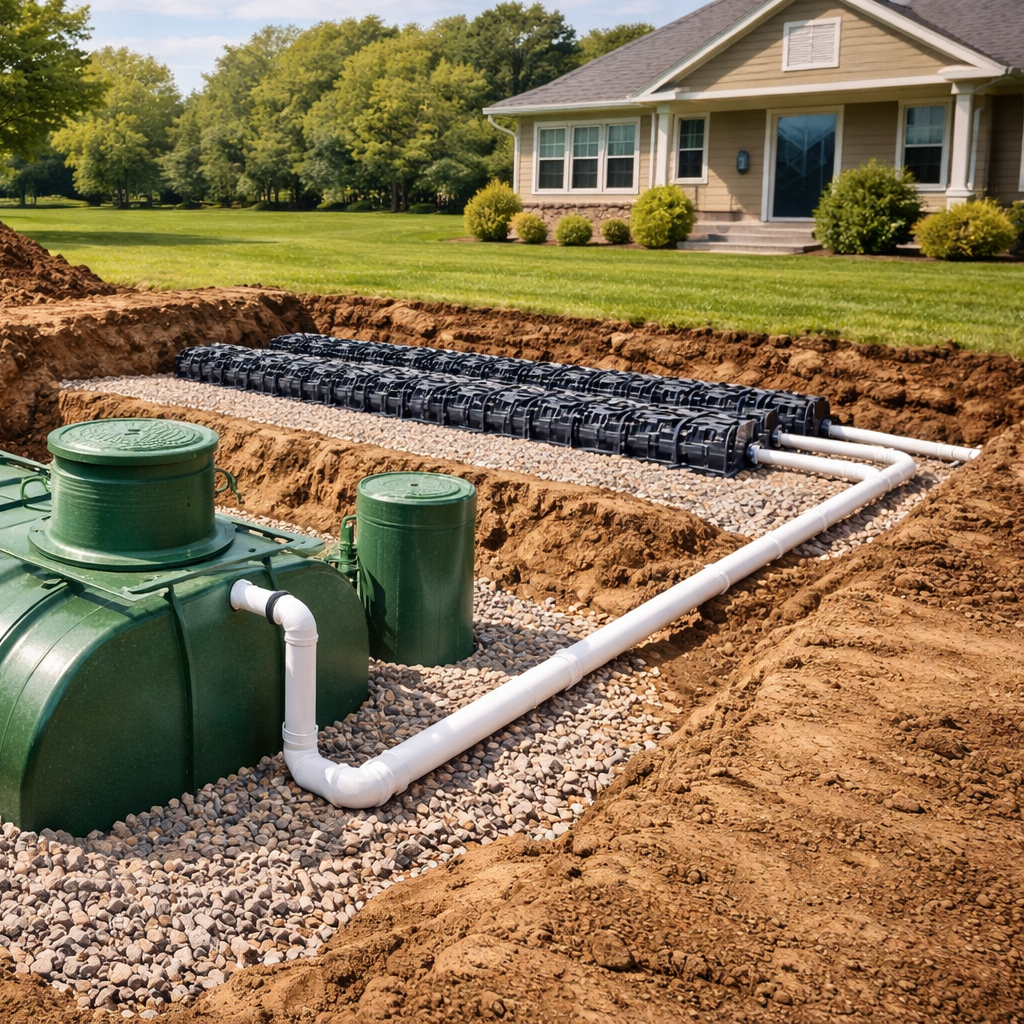
The call comes in on a Tuesday morning. Four residents are reporting backed-up toilets. The park manager drives the property and spots a soggy patch of ground near the middle of the lot — the smell hits before she's close enough to see the standing water. One tank, one failure, four homes affected. That's the part no single-family septic guide ever explains: in a mobile home park, the system serves a community, and a problem in the system is a problem for everyone.
Managing septic in a mobile home park isn't harder in some vague sense. It's harder in specific, predictable ways. Know what those are and you can stay ahead of most of them.
The Core Difference Is Load, Not Just Size
A residential septic tank serving a family of four handles roughly 400 gallons of wastewater per day. A mobile home park serving 20 homes can push 8,000 gallons through the same type of infrastructure — on a slow day. That math changes everything downstream.
More flow means faster sludge accumulation. More stress on the drain field. Any component sized for average load gets stressed faster when occupancy climbs or residents change their habits. A seasonal park can swing from 60% occupancy to full capacity in a weekend. The system doesn't know that's coming.
Here's the mechanism: sludge and scum build up in a septic tank continuously. The rate depends on how many people are using it. A residential tank might stay serviceable for 3–5 years between pump-outs. A shared community tank serving 8–10 homes needs pumping every 6–12 months. Push past that and solids start flowing into the drain field — and drain field repair costs dwarf pumping costs.
Individual Tanks vs. Shared Community Systems
Mobile home parks run one of two configurations, and each has its own maintenance rhythm.
| Configuration | How It Works | Maintenance Owner | Pump-Out Interval |
|---|---|---|---|
| Individual lot tanks | Each home has its own tank and drain field | Varies by lease | 2–3 years per unit |
| Shared community system | Multiple homes feed one central tank | Park operator | 6–12 months, based on occupancy |
| Package treatment plant | Engineered multi-unit system with active treatment | Park operator + licensed tech | Quarterly to annual, per state |
Parks with individual lot tanks have less centralized risk, but more individual points of failure. If a tenant ignores their tank until it backs up, the park manager still gets the call. With a shared system, every household's habits feed into the same tank. What one unit flushes is now everyone's problem.
Package treatment plants — common in larger parks with 20 or more units — fall under state environmental agency oversight rather than just local health departments. That means more documentation, scheduled inspections on a fixed calendar, and less room to defer maintenance when money is tight.
Why the Pump-Out Schedule Isn't Negotiable
Residential homeowners get away with flexible pump-out timing because the consequences are slow. A family that waits six years instead of five might see a sluggish drain but rarely a sewage backup. The buffer is bigger.
In a shared park system, that buffer is gone. Sludge accumulation accelerates with every unit connected. Twelve homes generating 150 gallons per bedroom per day fill a tank's scum layer faster than any single-household calculation would suggest. The tank wasn't undersized. It's running exactly as designed. It just needs to be emptied more often.
Think of it like a high-traffic gas station restroom versus the one at a private house. Same basic plumbing. One needs attention every few hours; the other once a week. The fixture isn't different — the use rate is.
Lift Stations: The Component Most Parks Have That Houses Don't
Residential homes rarely need lift stations. Mobile home parks often do — especially parks on flat lots, in low-lying areas, or where infrastructure was built in phases over decades.
A lift station is a pumping chamber that moves wastewater uphill when gravity can't. It holds submersible pumps, float switches, and a control panel. When it works, nobody thinks about it. When it fails — usually because a float switch corrodes or a pump burns out — the backup doesn't stay inside the chamber. It comes up through the lowest drain in the system, which is often a resident's bathroom floor.
Lift station maintenance in a park means scheduled cleaning of the wet well, testing float switches before they fail rather than after, and checking the control panel for alarms that have been silenced instead of investigated. Most parks should have the lift station serviced every 3–6 months. A failed lift station in a multi-unit park is an emergency that can affect dozens of residents. It doesn't wait for Monday morning.
When One Home's Problem Becomes Everyone's Problem
This is the part that's hardest to explain to residents who've only ever lived on single-family septic.
In a shared system, every household's behavior affects the tank's health. One unit flushing paper towels, one unit running a short-term rental with 10 guests instead of three, one unit pouring grease down the kitchen drain — those are cumulative loads on a tank that wasn't sized for them. And the family that does everything right is just as likely to end up with a sewage backup as the one that caused the problem.
This is why resident education isn't optional in a park setting. It's part of the maintenance program. Clear, specific guidance about what goes in the toilet — distributed to every incoming resident and reviewed annually — reduces service calls, extends pump-out intervals, and keeps the drain field out of trouble. It's also the first thing that gets skipped when you're managing 40 units and your day is already full. Don't skip it.
What a Maintenance Schedule Actually Looks Like
Here's a realistic cadence for a mid-size park with 15–30 units on a shared or semi-shared system:
| Task | Frequency | Why It Matters |
|---|---|---|
| Septic tank pump-out | Every 6–12 months | Prevents solids from reaching the drain field |
| System inspection (tank + drain field) | Quarterly | Catches problems before they surface in residents' homes |
| Lift station service | Every 3–6 months | Float switches and pumps degrade with continuous use |
| Camera inspection of main line | Annually or after any backup | Finds root intrusion, pipe damage, or buildup you can't see |
| Resident guidelines distribution | On move-in + annually | Reduces improper flushing and extends system life |
A park that follows this schedule reliably spends less on emergency services over time. The tradeoff is planned maintenance cost instead of emergency repair cost — and emergency repair in a multi-unit setting runs significantly higher because the problem is usually much bigger by the time anyone calls.
Frequently Asked Questions
Not necessarily a different type, but almost always a larger one sized for the total number of units and their combined daily flow. Parks with 20 or more units often use package treatment plants — engineered systems regulated by state environmental agencies rather than just local health departments. The components are similar to residential systems, but the scale and oversight requirements are different.
Every 6–12 months is a reasonable baseline for most parks, but the real answer depends on occupancy, tank size, and the number of units connected. A park running at 90% occupancy with a system sized for 70% will need service closer to every 6 months. Quarterly checks of the tank level are the best way to dial in the right interval for your specific setup.
In a shared system, sewage that has nowhere to go finds another path — surfacing near the tank, backing up into an adjacent unit, or starting to overwhelm the drain field. The resident's problem doesn't stay in their home. This is why park operators need a clear policy on reported backups and how quickly they get escalated to a septic technician.
Yes. Individual tanks behave more like residential septic — each one serves one household and has its own drain field. They generally need pumping every 2–3 years, though occupancy affects that. The complication is accountability: in most leases, the park operator is responsible for maintenance regardless of what the tenant caused. Keep records of every pump-out and inspection so you can document compliance over time.
No — parks on sloped land with good natural drainage may rely entirely on gravity. But parks on flat lots, parks that expanded in phases, or parks in low-lying areas almost always have at least one. If your park has a lift station and it hasn't been serviced in over a year, that's where to start.
Waiting for a complaint. By the time a resident calls about a slow drain or an odor near the tank area, the system is already stressed. Scheduled pump-outs, quarterly inspections, and lift station checks are what catch problems inside the tank — before they show up inside anyone's home.
Run the Infrastructure, Then Let Residents Live There
Septic in a mobile home park should be invisible to the people living there. That doesn't happen by accident. It takes a schedule, not a reaction plan. Pump on a regular interval, inspect the drain field before it shows symptoms, service the lift station before a float switch dies, and give every incoming resident clear guidance on what the system can and can't handle. None of it is complicated. It just has to actually happen.