
Ask enough people about septic maintenance, and someone will tell you about the valve you are supposed to turn twice a year, the way you rotate your tires. Spring one way, fall the other, and your drain field outlives you. It is tidy folklore, and what it leaves out is that most systems give you nothing to turn.
The hardware behind the story is real. A diverter valve exists; it does roughly what the folklore claims, and if your property has one, you would want to know where it sits. What the folklore gets wrong is how many systems carry one, what turning it buys you, and whose hand belongs on it. If yours has none, your question changes shape.
The Valve Behind the Folklore
Strip the folklore away, and the component is simple. A diverter valve, also called a flow control valve, sits on the line carrying effluent out of the tank toward the soil. It works as a switch that chooses which of two or more destinations receives the wastewater, or splits it between two.
A destination, in that description, is a whole absorption area: a second field across the yard, a second bank of trenches nearby, or a seepage pit. Nothing about the effluent changes as it crosses the valve. The liquid arrives as it left the tank, and the only thing the valve alters is the address on it. A valve moves where your load lands, never how heavy it is.
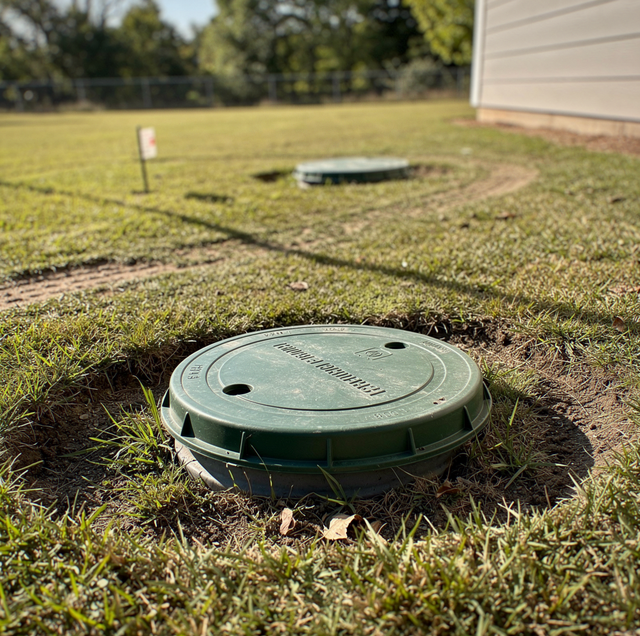
The valve itself is not much to look at. Most are a lever or a rotating plate inside a short chamber, set below grade under a lid, and some sit in a small box of their own off the tank. Others run automatically, cycling on a timer with no handle for anyone to find. All of them stay out of sight.
What the Ordinary System Looks Like
A conventional, soil-based system is one in which effluent leaves the tank and enters a series of perforated pipes buried in a leach field, chambers, or other units designed to release it slowly into the soil.
Count the destinations in that description, and you get one. A conventional layout has a single absorption area, and every gallon your household produces goes to it. There is no second address for the effluent, so there is nothing for a valve to choose between.
So the answer to the second half of the title is no. A valve belongs to a particular class of design, and if your system is the ordinary kind, yours has none and never needed one.
Three Things Buried Between Your Tank and Your Grass
| Component | Where it sits | What it does | Every system? |
|---|---|---|---|
| Diverter valve | On the outlet line, ahead of the soil | Sends flow to one absorption area or another | No |
| Distribution box | At the head of one field | Shares that field's flow among its own trenches | Common, not universal |
| Effluent filter | In the tank's outlet tee | Holds solids back before they reach the soil | No |
These three get confused because they all live under lids on the same lawn, and a homeowner who has heard of any one of them assumes the one on the property is that one. The test that separates them is how many absorption areas sit downstream. A distribution box has one field below it. A valve has two areas below it and picks between them.
The difference matters on the day someone works on your system. A crew leveling a distribution box is balancing one field against itself, while a technician turning a valve is taking one field out of service and putting another in. Only the second job needs a second field that still takes water.
What Sheds the Load While the Other Field Rests?
The design that needs a valve is called an alternating bed system, built to reduce hydraulic overloading of the drainfield soil by switching effluent distribution between two or more sets of drainfield trenches. Hydraulic overloading is the failure the whole arrangement is built against. Soil takes up water only at the rate its texture allows, and a field asked for more than that will stay wet between doses instead of draining. Nothing about the household has to change for it to happen; the ground simply cannot keep up with what arrives.
An overloaded drainfield can flood, sending sewage to the ground surface or backing it up into toilets and sinks. Resting a field works on the layer where the overloading first shows up. At the trench wall, bacteria and their byproducts build a dense film, and it thickens toward whatever feeds it until it begins to seal the surface it lives on. Cut the supply off and the film has nothing arriving: it thins, air works back into the pore space, and the soil below drains the water it was holding.
The second field carries your household in the meantime, which is the only reason the first can be starved for months without your plumbing noticing. That is the sense in which the arrangement is a backup rather than a luxury. One state's own rules define an alternating bed system as an absorption system designed with a backup absorption field for use while the primary absorption field rests. Both halves of the bargain sit in that wording: you own twice the absorption area you need on any given day, and each half spends part of every cycle recovering.
How Often the Switch Moves, and Whose Hand Moves It
The cycle is slower than the folklore suggests. Alternating fields typically run on a rotation of six months or longer, which is a schedule and not a season, and the interval comes from the design and the soil, never from your kitchen calendar. A field that has spent half a year under load needs comparable time with nothing arriving before its trench wall is in any different condition.
On the operating end, the same reference notes that alternating drainfield designs are most often used on flat sites and in combination with a programmable or timed automatic distributing valve, but they may also be operated manually. An automatic unit switches itself and leaves nothing to remember. A manual valve is the one that gave rise to the folklore, and it needs somebody to go turn it.
That somebody should be the technician on a service visit, not you on a Saturday. The valve sits below grade on the discharge side of a tank holding sewage, and reaching it means opening a buried lid over a void. A technician already there for a pump-out has the gear and the second person the job wants.
Never dig open a septic tank, distribution box or valve box lid to reach a diverter valve: have the septic technician locate and turn it, because an aged lid can fail under your weight and the void below holds sewer gas.
How to Learn Whether Yours Has One
Paperwork is the fastest route. A site plan drawn when the system went in shows the tank, the lines leaving it, and every absorption area on the lot; a plan with two fields on it means a valve is worth hunting for. Health departments in many areas keep permit records, and a request for the file on your address costs an afternoon.
Where the paperwork is gone, the ground still holds the answer. Count what leaves the tank. A single outlet line toward a single green rectangle is the conventional picture, while two lines, or one line reaching a chamber and two leaving it, point to a choice being made somewhere. Long dry spells help you see it, because turf over an absorption area in service often looks different from turf over one resting.
Guesswork on that scale is worth replacing. Mapping identifies the exact layout and boundaries of the field beneath the surface, helping locate distribution lines and absorption areas. A map with one absorption area ends your question, and a map with two gives the technician somewhere to look.
When Switching Fields Is the Wrong Move
A valve is not a repair. Where a field has already failed, the same reference warns that a drainfield clogged by a mature biomat needs considerably longer than a few months to recover, so throwing the handle buys you a working field and does nothing for the failed one. The rest interval that maintains a healthy field cannot rehabilitate a dead one, and treating a valve as the cure for soggy ground often ends in two failed fields.
The second field also has to be real. Plenty of properties carry an area marked on the plan as a reserve field that was never built, and some carry a second field that was built and then buried under a shed, a driveway, or fill. A handle that turns is no promise that anything on the other side can still take water, and finding that out after the switch is a poor way to learn it.
So the technician looks at the resting field before touching the handle. Its condition, its recent history, and whether the tank ahead of it is doing its own job all come first, because a switch made blind just moves your trouble across the yard. Turning a valve takes five seconds; earning the right to turn it takes the visit that comes before.
Frequently Asked Questions
Adding the valve is the small part. A valve only means something when a second absorption area exists for it to feed, and a second field takes a soil evaluation, a design, and open ground on your lot to put it. If your current field is healthy and sized for your household, you gain little from the work. If it is struggling, the conversation you want usually centers on repair or replacement.
Look between the tank and the fields, away from either end. A diverter valve usually sits in its own small chamber within a few feet of your tank outlet, under a lid that can sit flush with your lawn or lie buried under several inches of soil. Some sit inside a larger structure. If your system is automatic, you may find the controller in a panel on a post near your house.
Your system behaves as though it had one field, because it does. Every gallon keeps going to whichever side the handle was left on; that side carries your whole household load year after year, and the other side sits dry and unused. The loaded half ages at the pace any single field ages, which is the outcome the design was built to avoid. The unused half takes no harm from the wait, but it earns you nothing, and you paid for it when the system went in.
No, and the difference is worth keeping straight when you talk about your system. A distribution box takes one flow and shares it among the trenches of a single field, so everything downstream of it stays in service together. A valve chooses between whole absorption areas on your property, and the one it does not choose goes quiet until you switch.
Not much. Your tank fills with solids at a rate determined by your household size and daily habits, and the valve sits downstream of all that, so the pumping interval your inspection gives you is the same either way. What does change is the rest of your visit, since a rotation schedule and the condition of the resting field both become part of the job.
Two fields do not always mean alternating service. Some properties run both fields together all the time, with a splitting structure sharing the flow between them, because the soil could not absorb your household's daily volume through one field alone. Others have an old field that was abandoned when a new one went in, with the line to it capped or plugged, never valved. A third case is the reserve area, held empty on the site plan for a future replacement field and never connected to anything. Only a look at the plumbing between your tank and the ground tells you which of the three you own, and that look belongs to a locating visit, never to a walk around your yard.
If you are not sure whether your system has one field or two — drain field mapping, a septic tank inspection and pump-out, and drain field service are all handled here, and the map from that first visit answers the valve question for good. Heavy Duty Pumping & Septic LLC serves Lucedale, Leakesville, and Hurley, MS. Call (601) 804-2230.
