On the Friday of a holiday weekend, every site at a campground fills within a few hours. The bathhouse runs from early morning until late at night, the laundry barely stops, and the dump station takes a line of RVs on the way out. Then the place empties, and for weeks afterward the tank sees almost nothing. That swing, from near-idle to full capacity and back again inside a few days, is what a facility's septic service has to be built around.
A house never produces that shape of demand. Household flow rises and falls through the day but stays inside a narrow band the tank was sized for, which is why a residential interval can be set once and mostly left alone. A facility with sites, hookups, and shared buildings has no steady baseline to set an interval against: the interval has to follow the load the system actually receives, weekend by weekend.
What follows is not a symptom list but rather the specific ways a recreation facility's waste stream differs from a house's, and how each difference affects how service is scheduled.
| Load Source | What It Does to the System | What It Changes About Service |
|---|---|---|
| Weekend occupancy surge | Cuts retention time, risks solids carryover | Interval tracks peak weekends, not average use |
| RV dump station | Delivers holding-tank waste already concentrated | Receiving tank needs its own inspection rhythm |
| Holding-tank chemicals | Slows or kills anaerobic bacteria in the tank | Digestion recovers slower after a heavy-chemical weekend |
| Wipes, paper, foreign material | Builds up faster with public-restroom traffic | Solids layer builds at a facility-specific rate |
| Bathhouse and laundry | Adds surfactant load and steady hydraulic volume | Field dosing and rest periods need separate tracking |
| Camp store or snack bar kitchen | Sends fats and oils toward the wastewater system | Needs its own interceptor service, its own schedule |
| Off-season idle stretch | Bacteria population declines with no feed | First busy weekend hits a system that isn't ready |
When Occupancy Peaks, So Does the Load
Hydraulic load versus organic load: a full campground on a holiday weekend doesn't just add water; it adds it fast, concentrated into checkout mornings and shared bathhouse hours. That's a hydraulic-load spike, and it often arrives alongside an organic-load spike, since a full facility produces more solids and waste strength per hour than a quiet weekday does.
Retention time and carryover: a septic tank works by giving wastewater time to separate. Solids settle to the bottom as sludge, fats and lighter material float as a scum layer on top, and the clarified liquid in the middle, the layer that moves on toward the drain field, only leaves once it has had time to settle. Retention time is what gets cut short when more water arrives than the tank was built to hold in a given stretch. Water moves through faster, solids that would normally settle get carried out with it, and the drain field starts receiving material it was never meant to absorb directly. A lift station moving effluent from sites lower than the tank sees that same surge concentrated into the same few hours, with no more slack in its timing than the tank itself has.
An operator running a facility with a defined number of sites has an advantage a homeowner doesn't: a known ceiling on how far occupancy can spike, and a record showing how often it actually gets there. That record, not a seasonal guess, is where the interval starts.
Never approach or open a dump station's receiving tank, a septic tank, or a lift station wet well. These are confined spaces where hydrogen sulfide and oxygen displacement can incapacitate someone in seconds; entry is specialist work needing atmospheric monitoring equipment.
What Arrives from the RV Dump Station
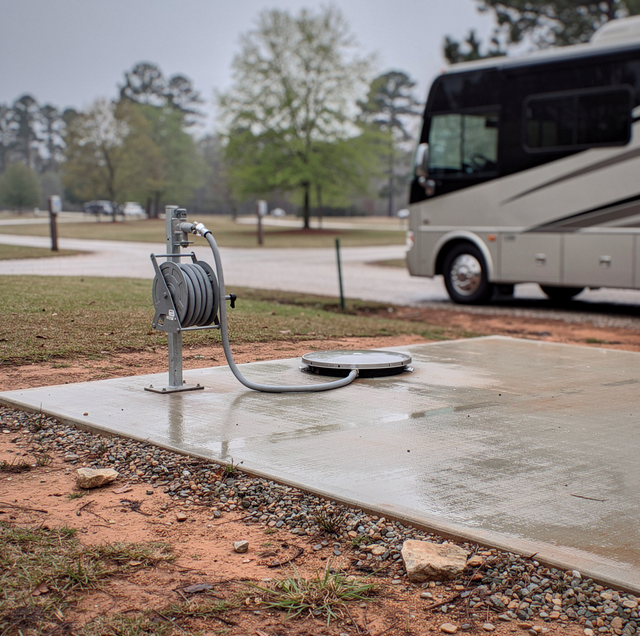
An RV's holding tank isn't fresh wastewater. By the time an owner empties it at a dump station, that tank has been collecting toilet waste for days, sitting warm, and often carrying a dose of holding-tank treatment chemical. What lands in a facility's receiving tank is waste that is already partly broken down and concentrated, arriving in a batch rather than a trickle. On a busy departure morning, several tanks might empty in sequence, each adding its own slug of already-septic material to a system that then processes it the same way it processes everything else headed for the tank and the field beyond it.
A dump station's receiving tank earns its own look during service. What accumulates there doesn't always match what accumulates at a bathhouse line or an individual site connection, and treating the whole facility as a single uniform load overlooks that difference.
Holding-Tank Chemicals and the Bacteria Doing the Work
A septic tank runs on anaerobic bacteria: organisms that live without oxygen and break solids down into liquid and gas over time. Many RV holding-tank treatments, including formaldehyde-based products still in circulation, are built to do one thing well: control odor by suppressing bacterial activity inside a small, sealed holding tank. That's the opposite of what's useful for whatever the tank empties into afterward. Once that treated waste reaches a septic tank, the same chemical that kept odor down in the RV continues to work, slowing or killing the bacterial population the septic system depends on to keep pace with everything else arriving behind it.
A single RV emptying a treated tank barely registers against a full system. A facility processing a steady run of holding-tank dumps over one weekend, a meaningful share of them chemically treated, is asking its bacterial population to recover from a real chemical hit on a rolling basis, a stress a household system, filled almost entirely by soap and food waste, doesn't have to contend with.
Wipes, Paper and Foreign Material at a Higher Rate
A facility with public or semi-public restrooms sees a volume of paper and wipes moving through its system that has little to do with how many people live on-site full time and everything to do with how many people pass through it. Public restroom traffic differs from that of a household bathroom: less predictable about what gets flushed, higher turnover, and less oversight of any one stall. The material itself isn't the core issue so much as the rate it arrives at. A solids layer that takes a household system a long stretch to build can build in a fraction of that time at a facility running near capacity on weekends, with an effluent filter downstream loading at that same accelerated rate.
The Bathhouse and Laundry Load
Shared bathhouses and on-site laundry add a load a private home's plumbing doesn't carry at the same scale: continuous hot water use, a higher concentration of soaps and surfactants, and hydraulic volume that runs for hours during a busy weekend rather than in the short bursts a household produces. Surfactants change how effluent behaves once it reaches the field, reducing surface tension and affecting how liquid moves through the ground beneath it. A field already carrying peak hydraulic volume from a bathhouse and laundry building at the same time it's absorbing weekend occupancy surge is under two kinds of stress a household field never sees stacked together. Rest periods between dosing cycles matter more under that combined load, not less.
Grease from the Camp Store or Snack Bar
A camp store, snack bar, or shared kitchen serving guests sends fats, oils, and grease toward the wastewater system the same as any food-service operation, and it needs its own interceptor service on its own schedule, kept apart from the septic tank serving sites and bathhouses. Folding a kitchen's grease output into the same interval as the rest of the facility's septic service misreads two systems with two different failure patterns as one.
The Season's Two Failure Points: Shutdown and Start-Up
A facility that closes or slows sharply in the off-season creates a problem of its own, easy to miss because it looks like the opposite of overload. Anaerobic bacteria need a steady feed to sustain their population; a tank that goes from full facility use to a skeleton crew, or to no one at all, sees that population decline right along with the incoming volume. A system sitting mostly idle for an extended stretch isn't resting in any useful sense. It's losing capacity to process what comes next.
What comes next is the opposite extreme: the first busy weekend of a new season, arriving all at once, at a system that hasn't processed a real load in months and is carrying a smaller bacterial population than it had at the previous season's peak. That combination, low readiness meeting high demand on the same weekend, is where a fair amount of early-season trouble starts, and it is a distinct problem from the peak-season surge, not the same thing under a different name. An interval built around only one of the two misses the other.
Building the Interval from Occupancy Records and Tank Condition
None of these point toward one number that works across every facility. A system's design, how many sites it serves, how those sites connect to the tank and field, and how a facility's occupancy varies throughout the year all shape which interval fits that specific system. What holds across all facilities is the method: the interval is built from that facility's own record rather than borrowed from a schedule.
The system's design sets the baseline: what it was built to receive, and how much margin it carries above an average load. The facility's own occupancy record, kept against actual site-nights or dump-station counts rather than a rough seasonal impression, shows how often and how hard that margin gets tested. What the tank looks like when it's opened for scheduled service- the depth of the sludge and scum layers relative to how long it's been since the last visit- tells an operator whether the current interval is holding up or running behind. A camera run through the line between a building and the tank during service shows whether solids are collecting in the pipe run itself and not only inside the tank.
A monitoring or alarm panel tied to a lift station or dosing system is worth a routine glance, not just a check when an alarm sounds. A panel silently tripping and resetting can mean a system already running near its limit.
Put those sources together over a couple of seasons and a pattern emerges that's specific to one facility, not a generic guess borrowed from a house down the road or a park two states over. That's the interval worth keeping to.
Frequently Asked Questions
It can. An event outside the normal pattern, such as a holiday weekend that ran longer than usual or a mechanical issue at the dump station, is reason enough to request a check of the distribution box or an exposed riser between regular visits rather than waiting for the next scheduled one.
Largely, yes, with one addition. A marina's vessel pump-out station adds the same kind of slug load an RV dump station does, but a marina's washdown or fish-cleaning station can also send a batch of organic solids toward the system on a busy weekend that a landlocked campground never generates.
Often. A newer system's dosing siphon or pump can typically be adjusted to change how effluent is timed to the drain field, spreading a surge rather than releasing it all at once. An older gravity-fed system has no equivalent means of adjusting that timing.
Watch the bathhouse floor drains. A floor drain that empties slowly, or gurgles when a nearby fixture runs, is often where a facility first sees back-pressure from a system falling behind, and it usually shows there before anything is noticeable at a site hookup. Reporting it when it starts, rather than once it has worsened, gives a service provider a much earlier read.
It can. Antifreeze pushed through the plumbing as part of end-of-season winterizing typically ends up in the tank alongside the last holding-tank dumps of the year, adding one more chemical load right before the system sits largely idle.
Some facilities are built that way, with the bathhouse and laundry building tied to its own system rather than sharing one with the sites. Where that's the case, each system needs its own service record and its own interval; treating them as one facility with one schedule overlooks the fact that they carry entirely different loads.
Put a service interval on your facility's own record, not a guess — occupancy, system design, and tank condition get evaluated together. Heavy Duty Pumping & Septic LLC serves Lucedale, Leakesville, Hurley, MS. Call (601) 804-2230.
