
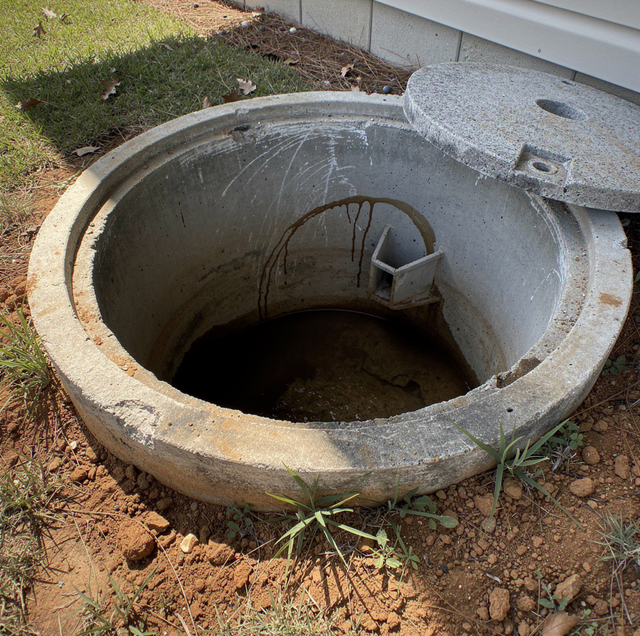
Quick Answer: A pump-out removes liquid, scum, and sludge, but a thin coating remains on the walls and baffles because a hose can't scrub a surface; that film is normal. A cracked wall or broken baffle is the real problem.
Stand at an open tank lid while a pump truck works, and what happens inside doesn't match the picture the word "pumped" puts in a homeowner's head. The hose pulls out liquid, floating scum, and settled sludge, but when the truck packs up, a coating still clings to the walls, the floor, and the fittings inside. That leftover film raises a fair question: how much should be left behind after a pump-out, and when does it mean the job wasn't finished?
An open tank lid is a fall-in point, and the gas above the liquid can drop a person before they smell a problem. Stay back while the truck works and let the crew handle the lid and any look inside.
What a Pump-Out Is Meant to Remove
A septic tank sorts everything that enters it into layers: fats, oils, and soap float to the top as scum; heavier solids settle to the bottom as sludge; and a clarified band of liquid, called effluent, sits between them and flows out to the drain field. A pump-out targets the two layers that don't belong past the tank, the scum and the sludge, along with the liquid holding them in suspension.
To pull that out, a technician opens the tank and breaks up the material with a hose or an agitation tool before drawing it into the truck, since a stiff scum crust or compacted sludge won't move through a vacuum hose on its own. The hose works down through whichever layer is present, pulling liquid, scum, and sludge out together rather than in separate steps. A technician reads the job as finished when the liquid draws down and what's left resists the suction, not when a specific depth reading is reached, because the tank tells the crew what will still move and what won't.
A Coating of Sludge Stays Behind Either Way
Even a careful pump-out leaves a thin film clinging to the tank walls, the floor, and the surfaces around the inlet and outlet baffles. A vacuum hose pulls out what it can draw into suspension; it doesn't scrub or wipe a surface the way a sponge would, so material stuck in corners and along seams stays put whether the tank is concrete, fiberglass, or plastic; none of them comes out of a pump-out wiped clean.
That residue isn't wasted effort or a sign the crew rushed the job. Some of the tank's bacteria live in that film, and once new wastewater starts flowing in, that residual colony helps restart the breakdown of solids rather than the system starting from scratch.
Some homeowners have heard advice to leave a few inches of sludge in the tank on purpose. A small amount of solids left behind after pumping can help the tank's bacteria rebuild, and the film on the walls and baffles further contributes. Asking a crew to stop inches short on purpose is a different request: sludge is the material a pump-out is meant to remove, and whatever is left on purpose is already counted toward the next pump-out.
When a Technician Won't Leave a Tank Sitting Empty
Groundwater that sits close to the surface presses against an emptied tank from outside, and once the liquid that normally weighs the tank down has been drawn out, that outside pressure can push the tank upward. System designs built for that kind of ground add anchoring or ballast to hold an empty tank in place until it fills again. Where the water table lies well beneath the tank, nothing outside is pushing up on it once it's empty, and flotation plays a smaller role in the design.
That's why a crew working where groundwater sits high doesn't leave a tank open and empty any longer than the inspection needs. Anchoring is one safeguard built into the design, and getting weight back into the tank promptly is another: a crew may leave some liquid rather than pumping bone dry, or close the lid and let normal household use refill it right away instead of treating "empty" as the finish line.
Baffles, Walls and Corrosion: What an Empty Tank Reveals
With the liquid and solids drawn down, a technician gets a clear look at surfaces a full tank never shows: the condition of the inlet and outlet baffles, the walls and lid, and any spot where root intrusion or corrosion has started. A tank that turns up cracked, corroded, or missing a baffle during this window is a separate problem from ordinary pump residue, and it turns the visit from routine maintenance into a repair conversation.
Short of that kind of damage, what a technician is really checking for is whether the baffles are intact and still positioned to do their job, keeping floating scum from drifting toward the outlet and keeping incoming waste from disturbing the settled sludge. A baffle that has slipped or broken loose lets solids reach the drain field no matter how well the rest of the pump-out went, so confirming it's solid is part of the visit, not an extra. Some crews note the baffle material and condition on the service record while the tank is open, since that observation becomes useful history the next time anyone opens the lid. The lid and riser get the same look: a metal lid rusted through or a concrete riser with a crumbling edge gets flagged for replacement, since either one is a hazard the next time someone stands near the opening, regardless of what's happening inside the tank.
What to Watch For and Ask While the Truck Is There
A homeowner doesn't need to inspect the tank directly to get useful information from the visit. Asking what the technician found when the lid came off, whether the baffles looked solid, whether there were signs of root intrusion, and whether the lids and risers were reset properly turns a routine service call into a record worth keeping for the next visit. A written note of what the tank looked like this time gives the next crew, or a different company entirely, something concrete to compare against, turning a one-time snapshot into a record that shows whether a problem is new or has been building for a while.
It's also fair to expect the tank to start filling again almost right away. As soon as the household runs a sink, uses a toilet, or does a load of laundry, wastewater flows back in, and normal use keeps the residual bacteria active rather than sitting idle. A pump-out that leaves the interior coated and a tank that resumes normal operation on the next flush is a system doing precisely what it's supposed to do, not one that needs a second visit.
Frequently Asked Questions
It helps. Running a washing machine, a dishwasher, or several showers back-to-back while the tank is being pumped keeps adding liquid on top of what the hose is drawing down, which can make the tank look like it isn't emptying. Holding off on heavy water use while the crew is on site gives an accurate read on what's actually left when they finish.
On a property where groundwater sits high, it can help to schedule around a stretch when groundwater is naturally lower, since lower groundwater means less water pushing up on the tank while it sits open and empty. Where the water table stays well beneath the tank, that scheduling consideration doesn't apply.
Yes, if the hose or an agitation tool strikes the inlet or outlet baffle while breaking up caked sludge. A careful operator keeps that tool away from the fittings, since a baffle knocked loose during pumping sends solids straight toward the drain field the next time the tank fills, undoing the point of the visit.
It can, indirectly. Risers make the tank's lids reachable without digging, so a full pump-out through every access port is practical at each visit. A tank with a buried lid over only one compartment may get only that compartment pumped if the crew never uncovers the other port, leaving that section's sludge and scum in place until the next visit.
It can. If effluent flows back into the tank through the outlet pipe once the level drops, the drain field may be holding water it isn't absorbing. That is worth a closer look at the field rather than another pumping, since pumping the tank again does nothing to change how the field itself drains. Noting when this happens on the service record gives the next visit something concrete to compare against.
A brief whiff while the tank re-equalizes and the crew closes the lids is normal. Odor that lingers for days afterward can point to a vent that isn't drawing properly or a lid or baffle that isn't sealing all the way, and that's worth a call back rather than something to wait out.
Book your next pump-out with a baffle and wall check — ask for a written note of what the crew found. Heavy Duty Pumping & Septic LLC serves Lucedale, Leakesville, Hurley, MS. Call (601) 804-2230.