
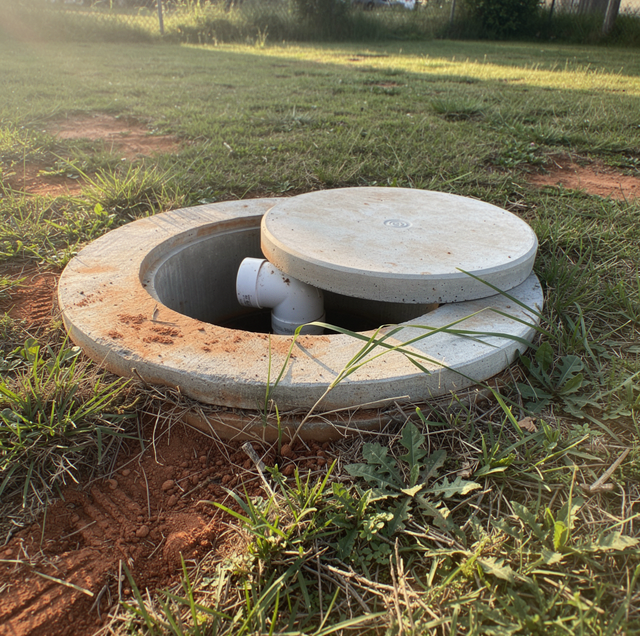
A septic system offers a root a path it does not find in ordinary ground: a line that stays wet, carries nutrients, and is stitched together with seams, joints, and access lids that are not built to stay root-tight forever. A root that reaches one of those openings grows toward the supply, not away from it, and what shows up above ground or inside the house depends on exactly which part it reached. A root sitting at the tank outlet reads differently than one growing into a single field lateral, so matching the sign to the part is the first step toward the right fix, before anyone decides what the repair needs to cover.
Where roots are the cause, each sign lines up with a likely part of the system:
| Sign | Part Roots Have Reached |
|---|---|
| Slow drains through the house again, not long after a pump-out visit | The tank outlet or the line feeding the distribution box |
| Gurgling right after a flush | A root mass narrowing the inlet or outlet baffle opening |
| A stripe of greener grass over one field line | That lateral, with effluent backing up behind the blockage |
| A root mat visible at the inlet or outlet once the lid is off | The pipe joint at the tank itself |
| An effluent filter packed with fine, fibrous roots | The outlet tee where the filter sits |
| Water standing in only one section of the field | Roots blocking the other outlets at the distribution box so this section takes all the flow, or roots inside this lateral backing effluent up |
Where Roots Get In
A septic system has several places built with a seam, and any seam is an opening a root can widen once it arrives. Lid and riser seams sit close to grade, closed only with a gasket or a mortar joint, so a root growing along the surface can reach one without going deep at all. The inlet and outlet pipe joints, where a pipe passes through the tank wall, are another point roots reach for, since wastewater runs on one side of that joint and a small gap sits on the other; a root that gets a foothold there can pry the same joint further open the longer it stays in place, and it can widen an existing crack in a tank wall the same way. The baffles, the fittings that keep incoming waste and floating scum from reaching the outlet, sit close enough to that joint that a root working it can foul the baffle too, even when the tank shell itself is sound.
Past the tank, the distribution box divides flow from a single line into each lateral running out to the field, and it carries the same kind of seam at every pipe entering or leaving it: its own lid gasket, plus a knockout for each line. A root reaching the box through either one can affect multiple lines at once, which is part of why a distribution-box intrusion reads differently in the yard than a single blocked lateral does. The field lines carry the same risk through their own run of perforations, and a root that finds one of those openings grows toward the same wet, nutrient-rich supply as any other entry point on the system.
Root Evidence Once the Tank Is Drawn Down
A pump-out that draws the tank down for cleaning also gives a crew its clearest look inside, allowing them to check the baffles, among other things, that the visit is meant to confirm. With the liquid and sludge out of the way, root evidence can be visible directly: a mat of fine, fibrous roots wrapped around the inlet or outlet fitting, or that same growth threaded through an effluent filter fitted into the outlet tee on tanks that have one. A root mass found at the outlet during a pump-out can be the first hard evidence of intrusion a homeowner sees, since it can sit there for a stretch before it restricts flow enough to slow the drains inside the house. A crew that spots it during a routine visit has caught the problem before it announced itself any other way.
A septic tank holds gas that can overcome a person within seconds, and an old lid can give way underfoot. The pumping crew checks root evidence at the inlet or outlet from above the opening, or with a camera.
How Roots Are Confirmed
Visible root evidence at the tank answers half the question; a camera run down the lines answers the rest, showing where a root mass sits inside a pipe that cannot be seen by eye, how far it reaches toward the field, and whether it has pried a joint open enough to let solids past it. The camera cable itself carries a distance counter, so the footage showing where the growth starts and ends is logged against the cable's reading rather than an estimate walked off from the tank. Locating the lines themselves, tying the distribution box and each lateral to a fixed point above ground, is its own service, and it is the step that turns a confirmed root problem into a map of exactly where the work needs to happen, rather than a guess at where to start digging.
Cutting and Jetting Roots Out of the Lines
Removing a root mass from a distribution box or a field line combines two tools: a cutting head that shears the root mass out of the pipe, and a jetting head that follows behind it, using pressurized water to scour any fine root hair and buildup left by the cutter on the pipe wall. Root cutting and jetting inside the septic system's own lines are a separate job from clearing roots from the main sewer line that connects the house to the tank, which uses the same pair of tools on a different pipe. Once the line runs clear, the opening that let the root in still needs attention: a joint that has been pried open gets resealed, and a baffle that has been fouled or displaced gets reset or replaced, because clearing the root without addressing what let it in leaves the same opening for the next one. Where the damage is at the distribution box rather than a single joint, resetting the box level again matters as much as sealing it, since a box tilted even slightly sends more flow to whichever line sits lowest and starves the rest regardless of how clean the lines themselves are afterward.
None of this calls for do-it-yourself digging or chemicals poured down a drain. A drain chemical is diluted in the tank before any of it moves on, and it does nothing about the joint or seam that let the root in. While driving or digging near a line to look for roots, the risk of crushing the pipe being checked is high. If a backup shows up inside the house before any of this is addressed, stop using water and call for service rather than waiting it out.
When a Root Problem Comes Back
A line cleared of roots, without resealing the joint it grew in, can draw new roots back to the same spot, so closing that opening is as much a part of the fix as the cutting and jetting were. A tank or field that has already shown one intrusion is also a good candidate for a professional to confirm the repair is holding at the next visit.
Frequently Asked Questions
Yes. Roots can enter through the lid, riser, and pipe-joint seams on a sound shell, and on some tanks, a technician fits a flexible sealed boot around the pipe where it enters, closing that joint without touching the rest of the tank.
Yes. A riser added later puts a new joint between the riser and the tank's lid opening, a seam the tank did not have when it went in, and that joint is resealed whenever the riser is reset.
On systems with a second distribution box downstream of the first, a root mass blocking the first box can cut off flow to every lateral fed by the second box.
No. A root mass can fill the bore of a feed line, so that lateral carries no flow at all rather than reduced flow.
Not through the sealed gap itself; roots nearby can still find another seam, which is why the rest of the tank, box, and lines are checked during the same inspection.
Liquid standing above the outlet invert when the lid is off, rather than level with the bottom of the outlet pipe. Roots narrowing the outlet hold wastewater back that way, and so can a field that has stopped taking effluent, which is why the outlet itself is checked before the level is read as a root sign.
Order root removal and a septic inspection — root cutting and jetting in the lines, plus a check of the tank, distribution box, and field for where the roots got in. Heavy Duty Pumping & Septic LLC serves Lucedale, Leakesville, Hurley, MS. Call (601) 804-2230.