A septic system rarely fails all at once. Weeks or months before sewage backs up into a shower or surfaces in the yard, the system usually drops a series of quiet hints. Miss them, and you get an emergency: a foul, expensive, unsanitary mess that arrives on the system's schedule, not yours. Catch them, and you get a phone call and a scheduled pump instead. The difference between those two outcomes is almost always a matter of noticing the early signs and acting while they are still small.
Think of the warnings the way you would treat a slow tire leak. A tire that loses a little pressure each week gives you plenty of time to plug it in a warm garage. Ignore the gauge long enough, and you get a blowout on the highway. A septic system leaks warnings the same way, and the earlier you read the gauge, the cheaper and cleaner the fix.
How a Healthy Septic System Actually Works
Understanding the signs is easier once you know what the system is doing underground. Wastewater leaves the house and enters the tank, where it separates: heavier solids sink into a sludge layer at the bottom, grease and lighter material float to the top as scum, and the relatively clear liquid in the middle, called effluent, flows out to the drain field. Out in the field, the effluent trickles through perforated pipes and slowly soaks into the soil, where bacteria finish treating it.
Everything downstream depends on solids staying inside the tank. When too much sludge builds up, or when something chokes the outflow, the solids and dirty water have nowhere to go but back toward the house or up through the field. The early warning signs are simply the first symptoms of that pressure building where it should not.
Drains That Slow Down Over Weeks, Not Overnight
A single sink that suddenly stops draining is almost always a local clog: hair, grease, or a lodged object in that one pipe. That is a plumbing problem, not a septic problem.
The septic warning looks different. Several drains around the house become sluggish together, and it happens gradually over weeks. The kitchen sink empties a little slower this month than last, the tub takes its time, and the washing machine backs up now and then. When multiple fixtures slow in unison, the bottleneck is not in any one pipe. It is in the tank or the field, where everything drains to.
Gurgling Toilets and Drains
Listen for gurgling. When a toilet bubbles as a nearby tub drains, or a drain glugs and burps after you run water, air is being forced back through the plumbing because it cannot vent normally through a system that is filling up. Gurgling is one of the earliest audible signs, and it often shows up before any water is visibly slow.
Odors Indoors, at the Tank, or Drifting Across the Yard
A properly working system is sealed and vented, so you should not smell it. An occasional whiff of sewage indoors, near a floor drain or a rarely used bathroom, means gases are escaping where they should not. A faint sulfur or sewage smell outdoors near the tank lid or out over the drain field points in the same direction. The smell tends to come and go at first, stronger after heavy water use, which is why it is easy to dismiss. Do not.
A Drain Field That Looks Too Good
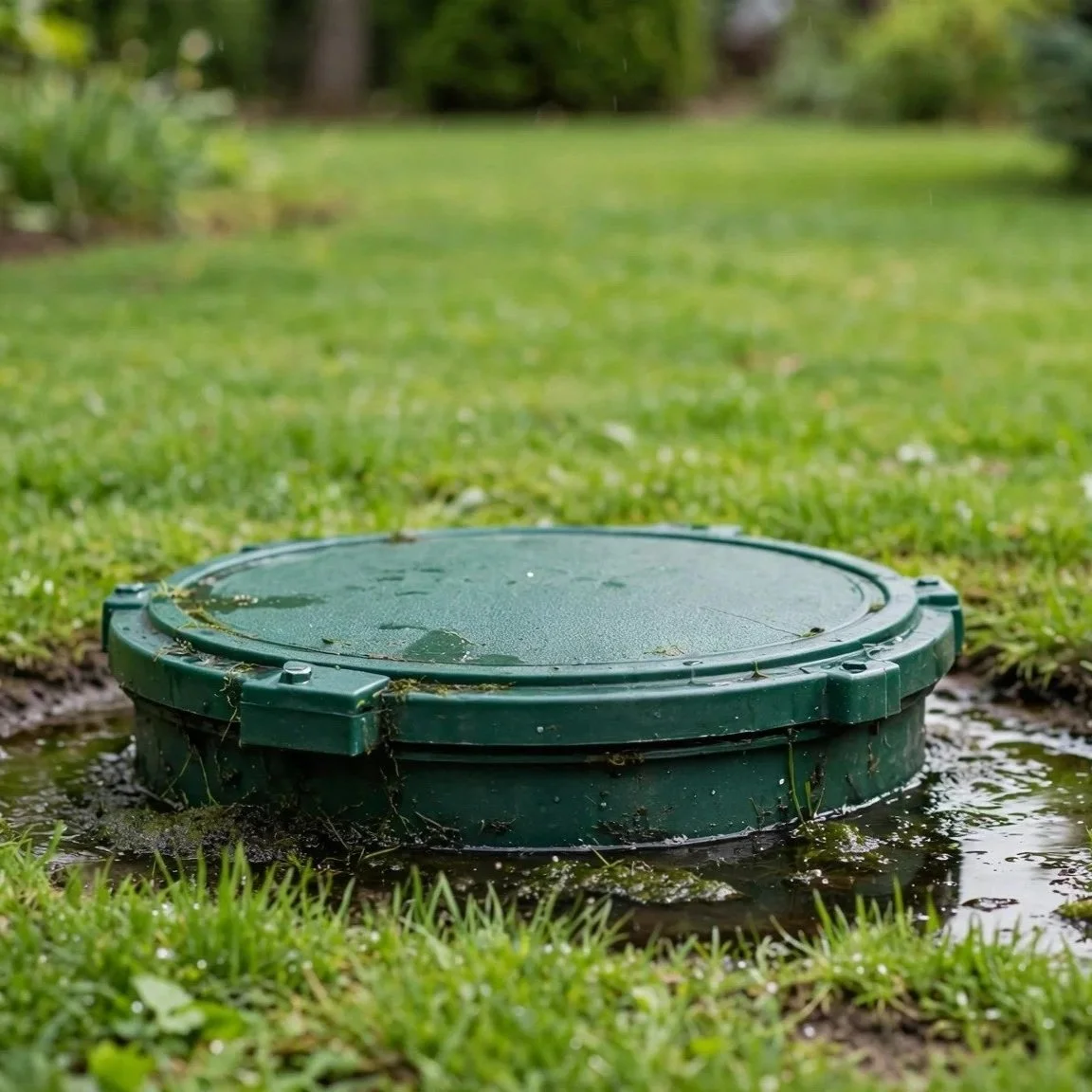
This one is counterintuitive. A strip of grass over the drain field that is noticeably greener, thicker, spongy underfoot, or wet when the rest of the yard is dry is not a sign of healthy soil. It usually means treated water is rising closer to the surface than it should, fertilizing and watering that patch from below. Standing water or a permanently damp area over the field is a louder version of the same warning.
Toilets That Flush Slow or Need a Second Flush
When a toilet that used to clear in one flush starts needing two flushes, or the bowl refills and drains slowly, the system is telling you it is struggling to accept new water. On its own, it might be a weak flush; combined with the other signs on this list, it is part of the pattern.
An Overdue Pumping Interval
Sometimes the clearest sign is on the calendar rather than in the yard. Every tank fills with solids at a predictable pace, and once the sludge and scum layers grow past what the tank can hold, solids start escaping into the drain field. How often a tank needs pumping depends mainly on tank size and how many people live in the house, so intervals vary widely from one property to the next. If you cannot remember the last pump-out, or you know the interval has passed, treat that as a warning in its own right, whether or not anything looks wrong yet.
How the Problem Progresses If You Wait
These signs are not random. They fall along a path that runs in one direction.
It usually starts with drains slowing and the occasional gurgle. Left alone, the slowing turns into backups, and backups always show up first at the lowest fixtures in the house, the basement floor drain or a ground-floor shower, because that is where gravity pulls the overflow. If the field itself is failing, the final stage is sewage surfacing over the drain field, wet and smelly on top of the ground.
Each stage is harder and more expensive to deal with than the last. A tank pumped on schedule is routine maintenance. Sewage on the floor is an emergency cleanup. A drain field that has been clogged by solids and stopped absorbing is the costly one, because a failed field often has to be repaired or replaced rather than simply cleaned. Almost every field failure started as a warning sign that went unread.
What To Do When You Notice the Early Signs
The whole point of catching the signs early is that early gives you options. A few practical moves:
- Track your pumping interval- Write down the date of every pump-out so you are not guessing. This is the single most effective habit for avoiding a surprise.
- Get an inspection- A septic professional can measure the sludge and scum layers, check the tank and outlet, and tell you whether you are near the line. An inspection turns a guess into a plan.
- Keep the effluent filter clean- If your tank has one, it needs periodic rinsing so it does not choke the outflow.
- Watch your water use- Spreading laundry across the week and fixing running toilets and drips reduces the load you push through the system, which buys time on a system that is getting close.
Early Warning Versus Active Emergency
There is an important line between the two, and which side you are on decides how fast you move.
An early warning is any of the signs above showing up while wastewater is still going down the drains: slow drains, a gurgle, an intermittent smell, or a green patch. That is a "schedule service soon" situation. You can call, pick a day, and have it handled on your terms.
An active emergency is different. Sewage backing up into the house, or wastewater surfacing in the yard, is a health hazard, not an inconvenience. When that happens, stop running water in the house immediately, keep people and pets away from the standing sewage, and call for service right away. Cutting water use stops you from pumping more into a system that already has nowhere to put it.
One safety rule holds in every case: never open and enter a septic tank yourself. The gases inside are toxic and can be fatal within seconds, and the confined space is dangerous even briefly. Inspecting, pumping, and repairing a septic system is professional work with the right equipment, and it should stay that way.
A Note on Rain and the Water Table
Ground conditions matter, and in low-lying areas, they matter more. When the soil around the drain field is saturated after heavy rain or a seasonally high water table, it simply cannot absorb effluent as fast, and even a sound system can back up briefly until the ground drains. The flip side is that a stretch of dry weather can mask a field that is already marginal, letting it limp along until the next wet spell exposes it. So, a backup that lines up with a big rain is not automatically a failure, but it is a strong hint to have a system inspected, because saturated ground is hardest on a field that was already close to the edge.
Read the signs early, keep up with the pumping interval, and a septic system will usually tell you what it needs long before it forces the issue.
Frequently Asked Questions
The tell is which drain acts up first. A septic blockage sits downstream in the main line or the tank, so the lowest drain in the house gives out first: a basement or floor drain, or a ground-floor tub, backs up before anything upstairs does. A normal clog, by contrast, sits inside one branch pipe and affects only the single fixture it serves. So a lone slow sink points to a local snag you can clear, while trouble that starts at the lowest point and works its way up points back to the tank or main line.
Richer soil or a dose of fertilizer makes grass greener, but leaves the ground dry and firm. A failing field does something different: the green strip is also spongy and wet underfoot, and it can carry a smell after rain. That is because the moisture feeding it is partially treated effluent surfacing from below, not the grass simply feeding on better dirt. So the combination of color, sponginess, and an odor is what separates a struggling field from a naturally lush patch of lawn.
There is no single number, because a common cadence is every three to five years, depending on tank size and household, and a smaller tank serving a full house reaches the line faster. Rather than going by the calendar alone, a pro gauges it by measuring the sludge and scum depth in the tank and comparing that to the tank's capacity. Once those layers grow past what the tank can hold, solids stop staying put and carry over into the field. So overdue is less about a set date and more about how full the tank has actually become.
Many tanks have a filter fitted on the outlet pipe whose job is to catch stray solids and keep them from reaching the drain field. Over time, that filter collects debris, and when it clogs, it chokes the outflow, so wastewater cannot leave the tank, and the whole system backs up toward the house. Rinsing the filter on a regular schedule is a simple, low-effort step that heads off that kind of emergency entirely.
Yes, and the timing tells you which one you are dealing with. A saturated field usually recovers within a few days once the ground drains, so a backup that clears as the weather dries out is hydraulic overload, a temporary case of the soil being too full to accept effluent. A backup that lingers in dry weather is the opposite signal: it points to true field failure rather than passing wet ground. Watching whether the problem resolves on its own after a dry spell is the simplest way to sort the two apart.
Servicing now means wastewater is still going down the drains, so you can book a pump and inspection on your own timeline and pick a convenient day. In an active emergency, the sequence is different: the first move is to stop all water use in the house so sewage cannot rise any further, then get immediate pumping. That pumping buys time and clears enough room for the field to be assessed once the crisis is contained. So the difference is not just cost but order of operations, since an emergency forces you to react in a fixed sequence rather than plan on your terms.
Book a septic inspection or pump-out today — catch the warning signs while they are still cheap and easy to fix. Heavy Duty Pumping & Septic LLC serves Lucedale, Leakesville, Hurley, and the Gulf Coast. Call (601) 804-2230 to schedule.
