Quick Answer: A septic effluent filter is a plastic cartridge that fits inside the tank's outlet tee. It catches suspended solids so only clarified liquid flows to the drain field, protecting the field from clogging. Clean it by pulling it out and hosing it back into the tank, usually at each pumping or once a year.
An effluent filter is one of the least understood parts of a septic system, yet it quietly does one of the most protective jobs in the whole setup. If you have never heard of one, you are not alone, and if your tank was installed decades ago, it may not even have one. This small plastic component sits inside the tank and screens what leaves it, and keeping it clean is one of the cheapest habits you can build into caring for your system.
To understand why the filter matters, it helps to follow the path wastewater takes after it leaves your house.
How Wastewater Moves From Tank To Drain Field
Everything that drains from your sinks, toilets, and washing machine flows into the septic tank first. Inside the tank, the waste separates into three layers. Heavy solids settle to the bottom and form a sludge layer. Grease and lighter material float to the top as a scum layer. In the middle sits a band of relatively clear liquid, called effluent.
Only that middle layer is supposed to leave the tank. It exits through an outlet on the discharge side and travels to the drain field, a network of perforated pipes buried in gravel-filled trenches. There, the liquid slowly seeps into the surrounding soil, which finishes treating it naturally before it rejoins the groundwater.
The whole system depends on one rule: solids stay in the tank, liquid goes to the field. When solids escape and reach the drain field, they clog the tiny pore spaces in the soil that let liquid pass through. Once those pores seal up, the field can no longer absorb water, and that is when a system fails. The effluent filter exists to keep that rule from breaking.
What The Effluent Filter Is And Where It Sits
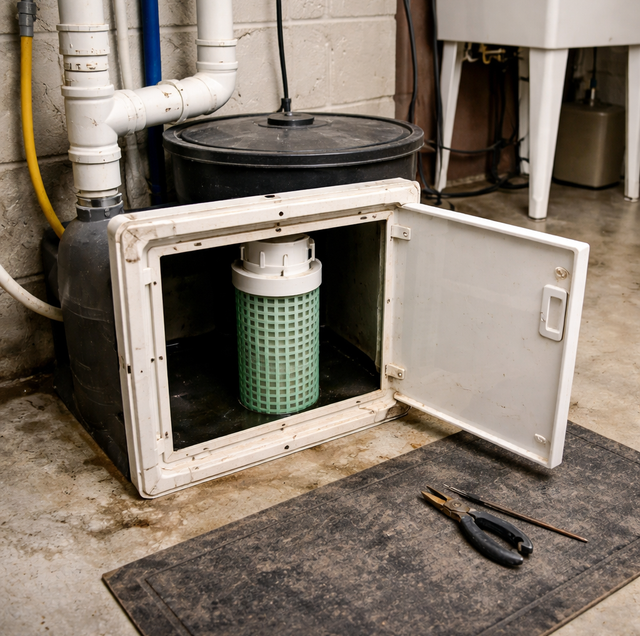
The effluent filter is a plastic cartridge, usually a series of stacked screens or a ribbed core, that slides down into the outlet tee on the discharge side of the tank. The outlet tee, sometimes called the outlet baffle, is the T-shaped fitting that draws liquid from the middle of the tank rather than the top or bottom. The filter sits right inside that fitting, so every drop headed for the drain field has to pass through it first.
Because it lives in the outlet and not the inlet, the filter only screens water on its way out. It does nothing to what comes in from the house. Access is from the tank lid or a smaller riser cap directly above the outlet, so a service tech can lift the filter straight up and out without disturbing the rest of the tank.
A useful way to think about the filter: it acts like the lint screen in a clothes dryer. The dryer runs fine whether or not you clean the screen, right up until enough lint builds that airflow chokes off. The effluent filter is the same idea for your septic tank. It quietly catches fine debris until, one day, it needs clearing, and ignoring it is what eventually causes a problem.
What The Filter Actually Does
Settling separates most solids inside the tank, but it is not perfect. Small particles stay suspended in the effluent layer, drifting in the water without sinking or floating. Left alone, they would ride the outflow straight into the drain field.
The filter screens out those suspended solids so that only clarified liquid reaches the field. The mesh openings are fine enough to trap particles down to a small fraction of an inch, holding back the material most likely to clog soil. What passes through is cleaner water that the drain field can absorb the way it was designed to.
The payoff is drain-field life. A field that only ever receives clarified effluent keeps its soil pores open and can keep absorbing water for many years. A field that receives a steady trickle of escaped solids clogs from the inside and fails far sooner. The filter is a small barrier standing between routine maintenance and a major repair.
Why It Matters So Much
The drain field is the most expensive part of a septic system to replace. Digging out failed trenches, hauling in new gravel and pipe, and restoring the yard runs into serious money and often means tearing up a good portion of the property. By contrast, a filter is a modest part and cleaning it is close to free.
Soil damage is also permanent in a practical sense. Once solids seal the pores in a drain field, you cannot simply flush them out. The clogged area stays clogged, and the fix is to build new trenches in fresh soil. That is why keeping solids in the tank matters more than almost anything else you do, and why a working, clean filter earns its keep many times over.
Signs The Filter Is Clogging
As the filter loads up with trapped material, it restricts how fast liquid can flow out of the tank. When outflow slows, the effects show up back inside the house, so the warning signs look a lot like a general septic backup:
- Drains throughout the house running slow, often the lowest fixtures first
- Gurgling from toilets or drains as air struggles past the restriction
- A sewage odor near the tank, the drains, or the yard
- In more advanced cases, wastewater backing up into the lowest drain or the toilet
Here is the part that surprises people: this is the filter doing its job. A restricted outflow is the filter holding back solids it was designed to catch. Rather than letting the material slip through to ruin the drain field, the filter clogs first and forces a visible symptom you will notice. The slow drain is an early, cheap warning, and answering it with a quick cleaning is far better than the alternative it is preventing. Treat these signs as a service reminder, not a system failure.
How To Maintain The Filter
Maintenance is refreshingly simple. At service time, the filter is pulled straight up out of the outlet tee and rinsed off, letting the trapped solids fall back into the tank where they belong. It goes back into the same slot, and the system is ready again.
How often: A common rhythm is to clean the filter every time the tank is pumped, and pumping is typically done every few years depending on tank size and household load. Many owners also give the filter a quick rinse once a year in between pumpings. Households that put more through the system need to clean it more often.
Clean the filter every time the tank is pumped, and give it a quick rinse once a year in between pumpings. A garbage disposal, a larger family, or heavy laundry days load the filter faster, so plan on cleaning more often if any of those apply.
What speeds up clogging: A garbage disposal is the big one, because it sends far more ground food solids into the tank than a kitchen without one. A larger family, frequent guests, or heavy laundry days all load the filter faster too. If any of these apply, plan on cleaning more frequently and watch for the slow-drain warning sign.
Pairing the filter with a regular pumping schedule is the whole strategy. Pumping removes the accumulated sludge and scum so the tank keeps separating waste properly, and the clean filter guards the outlet in between. One without the other leaves a gap. Together they are the core of keeping a septic system healthy for the long run.
A septic tank is a truly dangerous space, and the safety rules are not optional. The gases inside a tank, including hydrogen sulfide and methane, are toxic and can displace oxygen. Never lean into the tank, put your head over an open lid, or enter it for any reason. People have been overcome by tank gases in seconds, and the liquid depth is a drowning hazard on its own.
Cleaning the filter means pulling it up through the lid or riser opening only, keeping your face well away from the opening, and wearing gloves. The effluent and the filter are a biohazard, so rinse the filter back into the tank, never onto the ground or into a yard drain. When you are done, the lid has to be secured and seated properly. An unsecured or cracked lid is a fall-in hazard, especially for children and pets, so keep them away from the area entirely.
If any of this feels uncertain, that is the signal to have a septic professional handle it. They carry the right equipment, know how to work safely around tank gases, and can spot other issues while they are there.
Do Older Tanks Have One, And Can You Add It
Many older tanks were installed before effluent filters became a standard recommendation, so a good number of systems out there have never had one. If you have never seen or serviced a filter, and no one has ever pulled one during a pumping, it is entirely possible your tank does not have it.
The good news is that a filter can usually be retrofitted. During a pumping, when the tank is empty and accessible, a technician can fit a filter housing into the existing outlet tee on many standard tanks. It is a small upgrade that adds a meaningful layer of protection to a system that has been running without it. Ask about it the next time your tank is pumped, since that is the natural moment to add one.
Frequently Asked Questions
Physically, pulling and rinsing a filter is simple, but the surrounding risks are real. If the filter access is at a shallow riser you can reach without leaning over the main tank opening, and you wear gloves and keep your face clear, some owners do handle a quick rinse. If access requires opening the main lid or reaching down into the tank, leave it to a pro. The tank gases and fall-in risk are not worth a shortcut.
Common residential filters screen down to roughly one-sixteenth to one-thirty-second of an inch, depending on the model. Some housings accept interchangeable cartridges with finer or coarser screens, letting a technician match the filter to the household. Finer screens catch more but need cleaning more often, which is a trade-off a service pro weighs for your specific system.
No. The filter guards the outlet, but it does nothing about the sludge and scum building up inside the tank. Those layers still accumulate and still have to be pumped out on schedule. The filter and pumping solve different problems, and skipping pumping because you have a filter will eventually let solids overwhelm the tank entirely.
If the restriction is ignored long enough, wastewater can back up into the house through the lowest drains, and in some designs the mounting pressure can force material past or around the filter. That defeats the protection and starts sending solids to the drain field after all. A backup is also messy and costly to clean, so the slow-drain warning is worth acting on quickly.
Basic filters have no alarm at all, which is why the slow-drain symptom is the practical warning. Some advanced setups pair the filter with a high-liquid-level float and an audible or visual alarm in a control panel, which trips before a backup reaches the house. If your system has such a panel, a triggered alarm is your cue to schedule a filter cleaning right away.
The cartridge is durable plastic and can last many years, often the better part of a decade or more, as long as it is cleaned on schedule and not damaged during service. Cracked screens, warping, or a housing knocked loose are the usual reasons to replace one. A technician inspects the filter's condition each time it is pulled and swaps it if the screens no longer seat or seal correctly.
Protect your drain field before a small clog becomes a big repair — schedule a pumping and filter check with a team that has kept coastal systems running since 1988. Heavy Duty Pumping & Septic serves Lucedale, Ocean Springs, and Gulfport. Call (601) 804-2230.
