
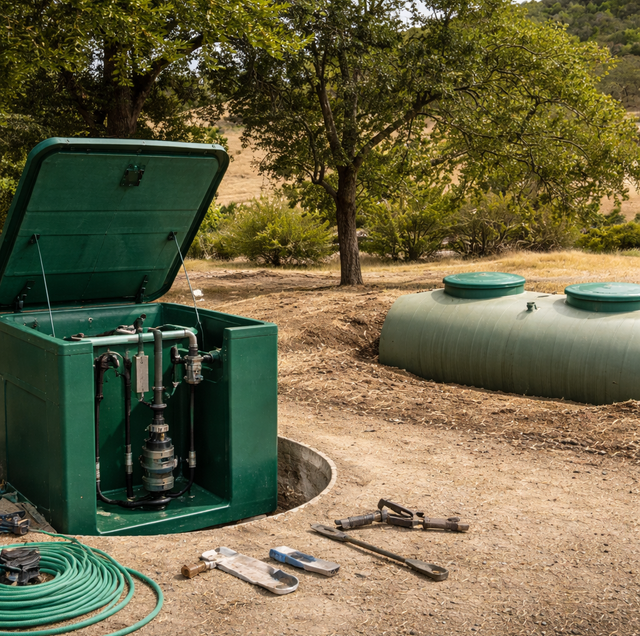
Quick Answer: A septic lift station is a sealed basin with a pump that collects wastewater and pushes it uphill when the tank or drain field sits higher than the plumbing draining into it. Gravity moves sewage downhill on its own, but when the destination is above the source, a float-controlled pump does the lifting. If the alarm sounds, stop using water and call a professional.
Most septic systems move waste the lazy way: downhill, on gravity alone. Pipes are pitched a fraction of an inch per foot, and everything that leaves the house rolls toward the tank and out to the drain field without a single moving part. It is quiet, cheap, and it almost never fails. So when a property has a humming box in the yard, a control panel on a post, and an alarm that goes off at two in the morning, it usually means gravity ran out of road. That box is a lift station, and understanding what it does takes the mystery out of the alarm.
What a Septic Lift Station Actually Is
A lift station, sometimes called a pump station or effluent pump chamber, is a watertight basin buried in the ground that catches wastewater and pumps it to somewhere higher than where it started. The name is literal. It lifts. Everything flowing into it arrives by gravity, but the outlet needs to go up, so a pump does the work that a downhill slope would otherwise do for free.
Think of a lift station as a relay runner standing at the bottom of a hill. Waste sprints downhill on its own momentum, then the pump takes the baton and carries it up the slope to the tank or drain field waiting above. Without that hand-off, the waste would simply pool at the low point and back up into the building.
When a property needs one: Not every septic system has a lift station, and that is by design. You only need one when the site's geography fights gravity flow. Common situations include:
- The drain field or leach area sits at a higher point than the house or the septic tank.
- The building's plumbing exits below the tank inlet, such as a basement bathroom or a slab addition that drains lower than the main tank.
- The septic tank is placed far from the field, and the ground rises in between.
- A commercial or high-occupancy site, like an RV park, campground, or shop, generates flow that has to travel across uneven ground to reach treatment.
In all of these, there is no continuous downhill path. The lift station bridges the gap by holding waste in a basin and pumping it over the high spot in timed bursts.
The Parts Inside a Lift Station
A lift station looks simple from the yard, but several components have to work together for it to run safely. Servicing any of them is professional work, because water and electricity share the same tight space and the basin holds toxic gas.
The basin or sump: This is the buried tank, usually fiberglass, polyethylene, or concrete, that collects incoming wastewater. It is sized to hold a working volume plus reserve capacity, so a normal surge of flow does not immediately overwhelm it. The basin is sealed to keep groundwater out and sewer gas in.
The pump: Two types are common. An effluent pump moves the relatively clear liquid that has already separated in a septic tank, sending it on to the drain field. A grinder pump is built for raw wastewater; it has cutting blades that shred solids into a slurry thin enough to push through a small-diameter pressurized line. Which one a system uses depends on where the basin sits in the treatment chain.
Float switches: Floats are the brain of the operation. They ride on the liquid surface like a fishing bobber, and as the level rises and falls, they tip on their internal switches to tell the pump when to run and when to rest. A typical setup uses separate floats for the pump-on level, the pump-off level, and the alarm level.
The control panel: Mounted above ground on a post or wall, the panel houses the electrical controls, breaker, and often a run counter or elapsed-time meter that a technician can read to judge pump health. It translates the float signals into power to the pump.
The high-water alarm: A separate float set higher than the pump-on float triggers an audible buzzer and a red light if the water climbs past where it should ever be. The alarm runs on its own circuit so it can still warn you even when the pump has lost power or failed.
The check valve: A check valve on the discharge line lets water flow only one way, out and up. When the pump shuts off, the check valve stops the column of water in the pipe from draining backward into the basin, which would otherwise make the pump cycle again a few seconds later for no reason.
How the Float-Controlled Pump Cycle Works
The whole system runs on a fill-and-empty rhythm, and no one has to touch it for it to happen.
Wastewater flows into the basin by gravity, and the level slowly rises. When it reaches the pump-on float, that float tips and closes its switch, telling the control panel to start the pump. The pump runs, pushing water up and out through the check valve, and the level in the basin drops. When it falls to the pump-off float, that switch opens, and the pump shuts down. The basin refills, and the cycle repeats.
A healthy pump moves a large slug of water in a short run, then rests for a long stretch. That pattern matters, because the pump is built to work in bursts, not to run continuously. The gap between cycles is what keeps the motor cool and the seals intact.
The high-water float sits above the pump-on float and does nothing at all during normal operation. It only comes into play when the water climbs past the level where the pump should have already cleared it, which means something is wrong.
Warning Signs of Trouble
Because the cycle is automatic, the first sign of a problem is usually the system breaking its own rhythm. Watch for these:
- The alarm sounds: The high-water float has been reached, meaning water is rising faster than the pump can clear it, or the pump is not clearing it at all.
- Backups or slow drains indoors: If the basin is full and cannot discharge, the next place for water to go is back up the pipes it came from.
- The pump runs constantly: A pump that never rests may be fighting a stuck-open check valve, a clog in the discharge line, or a float stuck in the on position. Continuous running burns out a motor fast.
- The pump never runs: Silence when the basin is filling points to a failed pump, a tripped breaker, a float stuck down, or a wiring fault.
- Gurgling, odors, or a soggy patch near the basin or field can signal that effluent is not making it to where it belongs.
Any one of these is a call to a professional, not a project to open up.
The basin holds hydrogen sulfide and other gases that can overcome a person in seconds, and the pump and panel put water and live electricity in the same box. Do not open the basin, reach inside, or try to reset the pump yourself.
Maintenance That Keeps It Running
A lift station is low-maintenance, not no-maintenance. A service visit checks the pump's draw and run time, tests each float by lifting it and confirming the pump and alarm respond, inspects the check valve for leak-back, and clears any grease or debris riding on the water surface that could snag a float. The alarm itself gets tested so you know it will actually sound when you need it.
Homeowners help most by watching what enters the system, since grease, wipes labeled flushable, and heavy solids are hard on floats and grinder pumps alike. Spreading out heavy water use, rather than running several loads of laundry back to back, keeps the basin from filling faster than the pump can empty it.
On the weather side, both extremes matter: a long dry stretch changes how the surrounding soil accepts effluent, while a heavy storm can raise groundwater around the basin and add stress to the field, so the system deserves attention in any season, not just one.
Why the Alarm Should Never Be Ignored
The alarm is the one part of the system designed purely to buy you time. It trips before a backup reaches your floors, giving you a window to act. Ignoring it, or worse, unplugging the buzzer to make the noise stop, throws away that window and lets the basin keep filling toward the building.
The right response is simple and safe. When the alarm sounds, stop using water: no laundry, no dishwasher, minimal flushing. Every gallon you keep out of the drains is a gallon the basin does not have to hold while you wait. Then call a professional. Do not open the basin, do not reach inside, and do not try to reset the pump yourself. Conserving water and picking up the phone are the two moves that protect both your property and your safety.
Frequently Asked Questions
A quality effluent or grinder pump generally lasts somewhere in the range of seven to ten years, though duty cycle drives that hard. A pump serving a large family or a busy commercial site cycles far more often and wears sooner, while a lightly used residential unit can exceed the range. A rising number on the panel's run-time meter is the early clue that a pump is aging before it fails outright.
No. The pump needs electricity, so an outage stops it, and effluent keeps arriving by gravity while the basin fills. The basin's reserve volume buys a limited window before the alarm trips, which is why conserving water during an outage matters. Some properties add a standby generator or a battery-backed alarm, but the pump itself will not lift without power.
No, though they look similar. A sump pump handles clean groundwater or rainwater and discharges it away from a foundation. A lift station handles wastewater or septic effluent, is fully sealed against gas escape, and often uses a grinder or effluent-rated pump built for solids and corrosive conditions that would destroy a standard sump pump quickly.
The clearest tell is a distinct gurgle or a rush of water back into the basin a few seconds after the pump stops, so a valve that has failed often announces itself by sound before the pump does. A technician confirms it by watching the basin level rebound right after shutoff. Two designs are common: a swing/flapper valve, whose rubber flap can warp or catch on stringy debris, and a spring-loaded ball valve, which seals better against back-pressure on a tall discharge run but costs a little head pressure. Where the pump lifts water many feet, some systems add a second check valve as backup so a single stuck flap does not idle the pump.
Most residential basins run roughly three to six feet deep, sized to hold both the working volume between pump cycles and a reserve above the alarm float. Depth also depends on how far below grade the incoming pipe sits. That confined depth, combined with the gas that collects inside, is exactly why entry is never a homeowner task.
A properly working pump is fairly quiet and runs only in short bursts, so a faint hum for a minute or two followed by a long silence is normal. Constant humming, grinding, or a pump you can hear running for many minutes at a time is not normal and points to a clog, a stuck float, or a failing check valve worth having checked.
Hearing an alarm or seeing a backup — get the pump checked before it reaches your floors. Heavy Duty Pumping & Septic LLC serves Lucedale, Leakesville, Hurley, MS. Call (601) 804-2230.
