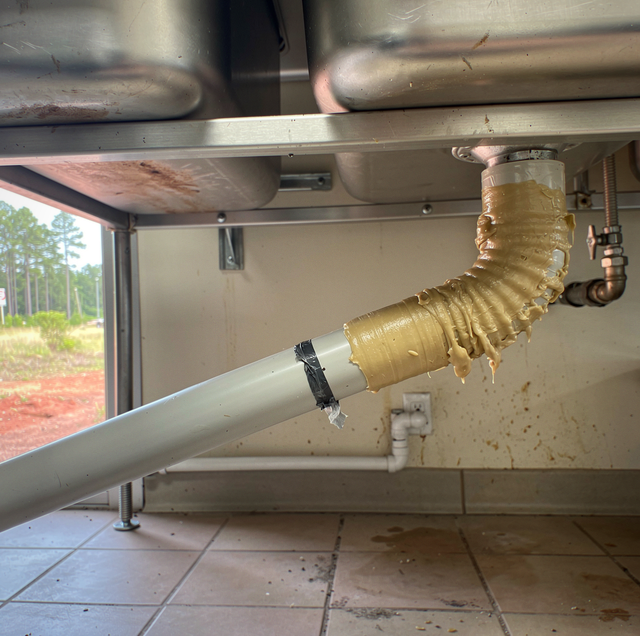
Every drain that carries hot water and food fat out of a kitchen empties into a run of pipe before that waste ever reaches a trap or interceptor. While the water and grease are still hot, the fat moves as a liquid, easy to mistake for something that has already left the building's plumbing behind, and it has not yet reached anything built to catch it. As that grease travels down the line, away from the heat of the sink or the dish machine, it loses temperature, and fat that was liquid a few feet back starts to bond to the inside of the pipe. That bonding happens gradually, one shift at a time, well before the coating is thick enough for anyone in the kitchen to notice a change at the drain. Each stage of that buildup, from a thin film no one would ever see to a blockage that stops the line outright, pairs with what a kitchen notices at the drain:
| Stage Inside the Line | What the Kitchen Notices |
|---|---|
| A thin film coats the pipe wall | Nothing at the drain; flow looks normal |
| The film narrows the open bore | Slower draining, an occasional gurgle at the fixture closest to the line |
| The bore closes to a full blockage | Standing water, backup at the nearest fixture, water finding another way out |
| Grease works past the trap or interceptor into the line beyond it | The fixture drains fine, but the smell or the backup shows up farther down the line, past the trap |
Why Grease Hardens in the Line
Fat, oil, and grease leave the trap as a liquid because they are hot. Once that liquid loses enough heat, it changes state, moving from a liquid that flows like water to one that clings to whatever it touches. Inside a pipe, that means the wall. How much of that run sits inside a warm kitchen versus a cold slab or an exterior wall shapes how much of the fat sets before it reaches the device meant to catch it.
Once a layer of fat has hardened on the pipe wall, it changes how the next batch of grease moves through. Cooling fat does not need to fully solidify to stick; it only needs to be thick enough to catch on a surface already covered with old deposits. That is why a coated line keeps coating itself: each new pass of warm, greasy water meets a wall already roughened by old deposits, and that roughness is what holds the next film in place. Line coating does not wait for the trap to fill. A trap pumped clean the same week can still sit behind a line that is already narrowing from grease that never reached it.
Bends and Low Spots Where Grease Collects
A straight run of pipe, sloped evenly toward the trap, moves wastewater through with a steady flow, and grease riding in that water spends less time in contact with the pipe wall before it clears the section it passes through. An elbow, a tee, or any change in direction breaks that even flow: water loses momentum at the turn, swirls instead of moving straight, and grease carried in it gets thrown against the pipe wall instead of past it. A belly in the line, where a section has settled or was never sloped correctly to begin with, holds standing water and grease long after the rest of the line has drained, giving that section time to cool and bond that a properly sloped run does not allow.
A coated bend narrows as each pass adds to the coating. A narrower opening speeds the water through the bend and breaks its straight flow into turbulence, which can throw grease against the pipe wall rather than carry it past the bend.
Chemical openers and boiling water poured into a grease-choked drain can spit caustic or scalding liquid back up, and a jetting hose under pressure can whip free. Leave a clogged grease line to the crew and keep staff clear.
Why Snaking Punches a Hole but Leaves the Coating
A cable with a cutting head bores a path through whatever is blocking the line, and that path restores flow: water moves again, a backup clears, and the immediate problem is over. What a cable does not do is clean the pipe wall it passed through. It cuts a channel through the center of the blockage and leaves the coating on the sides of the pipe largely intact, because the head is built to cut forward, not to scrub sideways against the full circumference of the pipe.
The next time hot, greasy water moves through that same section, it meets a rough, already-coated surface instead of clean pipe, so that stretch closes back in starting from a layer of old coating, where a scoured wall starts over from bare pipe.
How Jetting Scours the Full Pipe Wall
A jetting nozzle works differently. Instead of cutting a channel through the blockage, it pulls itself along the hose line while spraying pressurized water outward against the pipe wall, at angles designed to reach the full circumference of the pipe rather than just the center. That spray breaks the bond between the grease and the pipe rather than boring through it, so the hardened coating lifts free and moves downstream with the water instead of staying stuck to the wall. A jetted line returns to a closer-to-original open diameter, not just a hole punched through the buildup.
A cleanout cap set along the line between the kitchen and the trap or interceptor provides a mid-line access point, allowing a coated section to be reached and jetted without pulling a fixture or opening the trap itself.
Because jetting moves the grease it removes downstream instead of destroying it, that material has to end up somewhere. Timing a jetting visit close to a trap or interceptor pump-out matters for that reason: if jetted without a pump-out nearby, the grease flushed from the line has nowhere to go but into a trap or interceptor that may already be near its own limit.
Keeping the Trap and the Line on the Same Service Schedule
A line and the trap or interceptor at its end are not the same problem, but they are not independent either. A line that has been jetted clean still carries whatever hot, greasy water the kitchen sends down it, and that water starts coating the pipe again with the very next shift, so a jetted line on its own resets the clock rather than fixing anything for good. A trap pumped on schedule but fed by a line that has never been jetted can run into its own version of the same trouble, since some of what shows up as a slow drain or an odor traces to grease that coated the line on its way toward the trap, not grease that ever reached the trap for its own service to catch.
Treating the line and the device at its end as one system, rather than two separate calls placed at two separate times, means a jetting visit and a pump-out land in the same week, and the grease the jetting frees is pumped out with the trap.
Frequently Asked Questions
The hose goes in at an access point below the buildup, and the nozzle pulls itself upstream against the normal flow. Grease the spray lifts off the wall, then rides the water back down the line, away from the kitchen fixtures instead of toward them.
A cleanout gives the camera a straight entry into the line itself. Feeding it through a sink drain means passing the fixture's own trap bend first, which the head may not clear.
It can. Hot water and dish-machine detergent keep a portion of grease in a fine, emulsified suspension that slips past a trap instead of separating out inside it. That grease can still cool and re-bond to the pipe wall farther downstream, closer to the sewer tie-in, even when the trap itself is working as designed.
A camera run down the line after jetting checks the pipe wall itself, not just whether water is moving through it again. That step distinguishes a line that has been scoured clean from one where flow has been restored only through the center of a coating that still clings to the sides.
It can. An interceptor set outside the building, rather than a trap tucked under a sink, can mean a longer run of pipe between the kitchen and the device that is supposed to catch the grease, which gives that grease a longer stretch of cooling pipe to bond to before it ever reaches the interceptor.
The pattern separates the two. When one fixture slows or gurgles while others feeding the same trap still drain normally, the narrowing sits in the branch between that fixture and the trap. When every fixture on the trap slows together, the restriction sits at a point they all share: the common line leading into the trap, the trap itself, or the line beyond it.
Line up grease line jetting — the coating is scoured from the full pipe wall between the kitchen and the trap or interceptor. Heavy Duty Pumping & Septic LLC serves Lucedale, Leakesville, Hurley, MS. Call (601) 804-2230.