
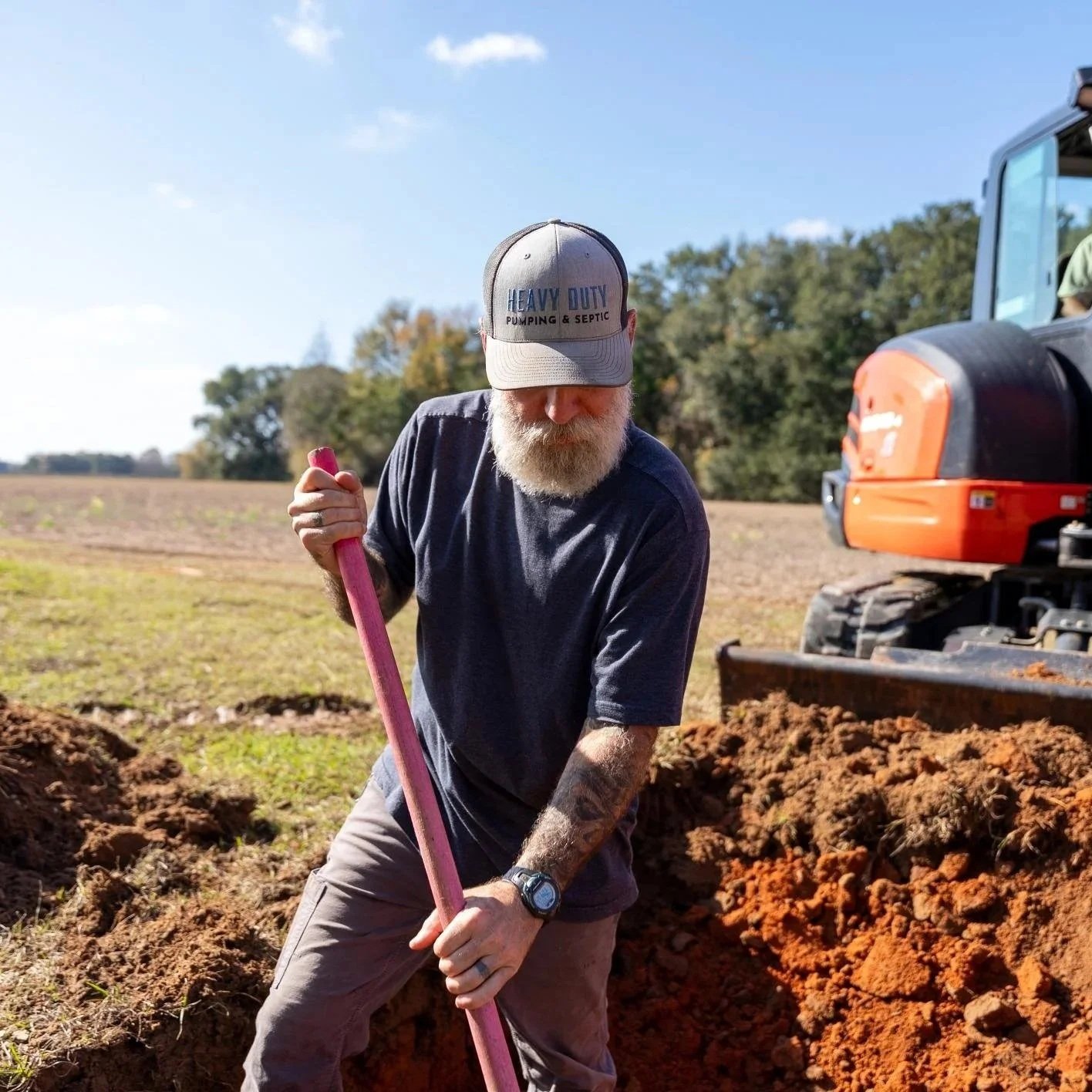
You have closed on the property. The house plans are drawn. The only thing standing between you and a functioning septic system is a sign-off from the county health department — and before they'll give it, they want to see soil test results. This surprises a lot of people. The tank goes in the ground, the drain field goes in the ground, the waste goes into the tank. What does the dirt have to do with it?
Everything, it turns out.
A septic system doesn't just store wastewater. It treats it. The final stage of that treatment happens in the soil underneath your drain field, where naturally occurring bacteria break down pathogens before the water moves through the ground and eventually joins the water table. If your soil can't do that job — if water moves through too fast, or doesn't move at all — you don't have a working septic system. You have a slow-motion contamination problem.
Soil testing tells you what the ground on your specific property can handle. That answer determines what system goes in, how big it needs to be, and where it can be placed. No good contractor will design a system without it.
What a Soil Test Actually Measures
Two distinct evaluations happen when a professional comes out to assess your site: a percolation test and a soil profile evaluation. They measure different things, and together they tell the full story.
| Test | What It Measures | How It Works |
|---|---|---|
| Percolation Test (Perc Test) | How fast water drains through saturated soil | Water poured into prepped holes; absorption rate timed in minutes per inch |
| Soil Profile Evaluation | Soil layers, texture, depth, and groundwater table position | Test pits dug to 4–6 feet; soil examined by layer, color, and structure |
The perc test gets most of the attention because the result — expressed in minutes per inch — feeds directly into the drain field sizing calculation. A rate of 1–30 minutes per inch is generally workable for a conventional system. Faster than that, and water is moving through the soil before bacteria have time to treat it. Slower than 60 minutes per inch, and the field will saturate faster than it can drain, backing the system up.
The soil profile evaluation adds the context the perc test can't give you. A technician or sanitarian digs down four to six feet and reads the layers. They're looking at texture — sand, silt, clay, loam — the depth before you hit a restrictive layer like hardpan or bedrock, signs of seasonal water saturation indicated by mottled gray and orange coloring in the soil, and how close the water table sits to the surface. A high water table is often a deal-breaker for a conventional system, even if the perc rate looks acceptable on its own.
Why the Soil Type Changes Everything
Most people know that clay drains slowly and sand drains fast. What isn't immediately obvious is why both extremes create problems, just in different ways.
In heavy clay soil, wastewater enters the drain field and sits. The soil doesn't absorb it fast enough to keep pace with household use, so liquid backs up into the tank, then into the house. Clay also tends to seal around perforated pipes, reducing absorption further over the life of the system.
Sandy soil has the opposite issue. Water moves through it so quickly that it barely makes contact with the bacteria responsible for treatment. Pathogens that should be trapped and broken down within the first couple feet of soil instead travel straight toward the water table. A perc test might show a rate of 2 or 3 minutes per inch — on paper, fine. In practice, the soil is doing too little treating.
The soil profile evaluation catches both of these conditions. The combination of perc rate plus layer depth plus groundwater position gives the designer enough information to match the right system to the actual site rather than guessing from the surface.
When the Test Comes Back With Problems
Bad soil test results don't automatically mean you can't install a septic system. They mean the system design has to compensate for what the soil can't do on its own.
For slow-draining soils, a sand mound or elevated drain field moves the treatment zone above the natural grade, using imported sand as a filter medium instead of relying on native soil. The system sits above ground level, covered with topsoil — it looks like a low berm across part of the yard.
For high water table conditions, an engineered system with a raised absorption area or a pressure-dosing setup delivers wastewater in timed pulses rather than all at once. This gives the soil recovery time between doses, preventing the saturation that would otherwise push effluent to the surface.
For soil that fails both tests — poor absorption and a water table too close to the surface — an aerobic treatment unit (ATU) may be the answer. ATUs treat wastewater before it ever reaches the soil by using oxygen and beneficial bacteria inside the tank itself. The effluent that exits to the drain field is already significantly cleaner, which reduces the treatment demand on marginal soil.
None of these alternatives are cheap. A conventional system for a typical house runs roughly $5,000–$12,000. A mound system adds $10,000–$20,000 to that range depending on the site. An ATU typically costs more than either. Knowing this before you buy land — or before you finalize the construction budget — is exactly the point of doing the soil test early.
The Permit Connection
In most states, you can't legally install a septic system without an approved design on file with the local health department or environmental agency. And those agencies won't approve a design without soil test results attached. The test is the first document in the permit chain.
This matters practically: if you skip the test and start installation, you could be ordered to dig the whole thing up. If you buy land with a failed or nonexistent soil test and build anyway, the liability follows the property. An inspector flagging it during a future sale can unravel the transaction entirely.
The permit process also puts a licensed sanitarian's eyes on the design. They're not just checking paperwork — they're confirming that the system as proposed actually matches what your site can support. The soil test is the common language between your contractor and the county.
Who Runs the Test and What to Expect
Soil tests for septic permits are typically run by a licensed soil scientist, a certified sanitarian, or the local health department itself. Your contractor can often recommend a professional who works regularly with the county — someone who knows how local officials interpret results and what the design criteria are for your area.
Expect the testing crew to dig two to four test pits across the proposed drain field area. They'll prep and pre-soak the holes the day before, then run the perc portion on the second day. The whole process takes one to two days on site. Lab analysis of soil samples, if needed, adds another week. Getting the full report back and into the permit application typically takes two to four weeks from start to sign-off, depending on how backed up the health department is.
Weather matters. Most states require perc testing during the wetter months, when soil moisture is at or near its seasonal peak. A test run on dry summer ground may pass a site that would fail in spring. Health departments know this and often restrict testing to certain times of year — check the requirements for your county before scheduling.
Frequently Asked Questions
No. Every parcel is different. Even adjacent lots can have dramatically different soil profiles depending on how the land was graded, filled, or used historically. Your neighbor's perc rate has no bearing on what you'll find three hundred feet away.
It's rare, but some sites genuinely can't accommodate a septic system of any design — usually due to extremely high water tables, shallow bedrock, or soil that refuses to absorb at any meaningful rate. In those cases, you're looking at connecting to municipal sewer if it's available, or reconsidering the project altogether. This is exactly the scenario you want to discover before you've built.
Not always. If the existing system failed due to a mechanical issue — a cracked tank, a broken pump — you generally don't need to retest the soil. If the drain field itself failed and you're installing a new one in a different location, a fresh soil evaluation is typically required before the county will approve the new design.
Most county health departments accept a soil test conducted within the past two to five years, as long as site conditions haven't changed significantly. If the land was graded, filled, or regraded since the original test, expect to retest before the agency will use the old results.
In most climates, frozen or snow-covered ground makes testing impossible. A few southern states can test year-round because the ground doesn't freeze deeply. Check with your county — they'll tell you the approved testing window for your area.
The perc test is one part of the full site evaluation. Many people use the terms interchangeably, but a complete assessment also includes the soil profile evaluation — the deeper look at layer structure, restrictive horizons, and water table depth. Both are typically required before a design can be permitted.
The Step That Determines Everything Else
A soil test isn't a formality. It's the only way to know what you're working with before you commit to a system design, a lot purchase, or a construction budget. Getting the results early gives you real information to make decisions with. Getting them late — after the plans are set and the money is spent — often means redesigning around a constraint you didn't know was there.