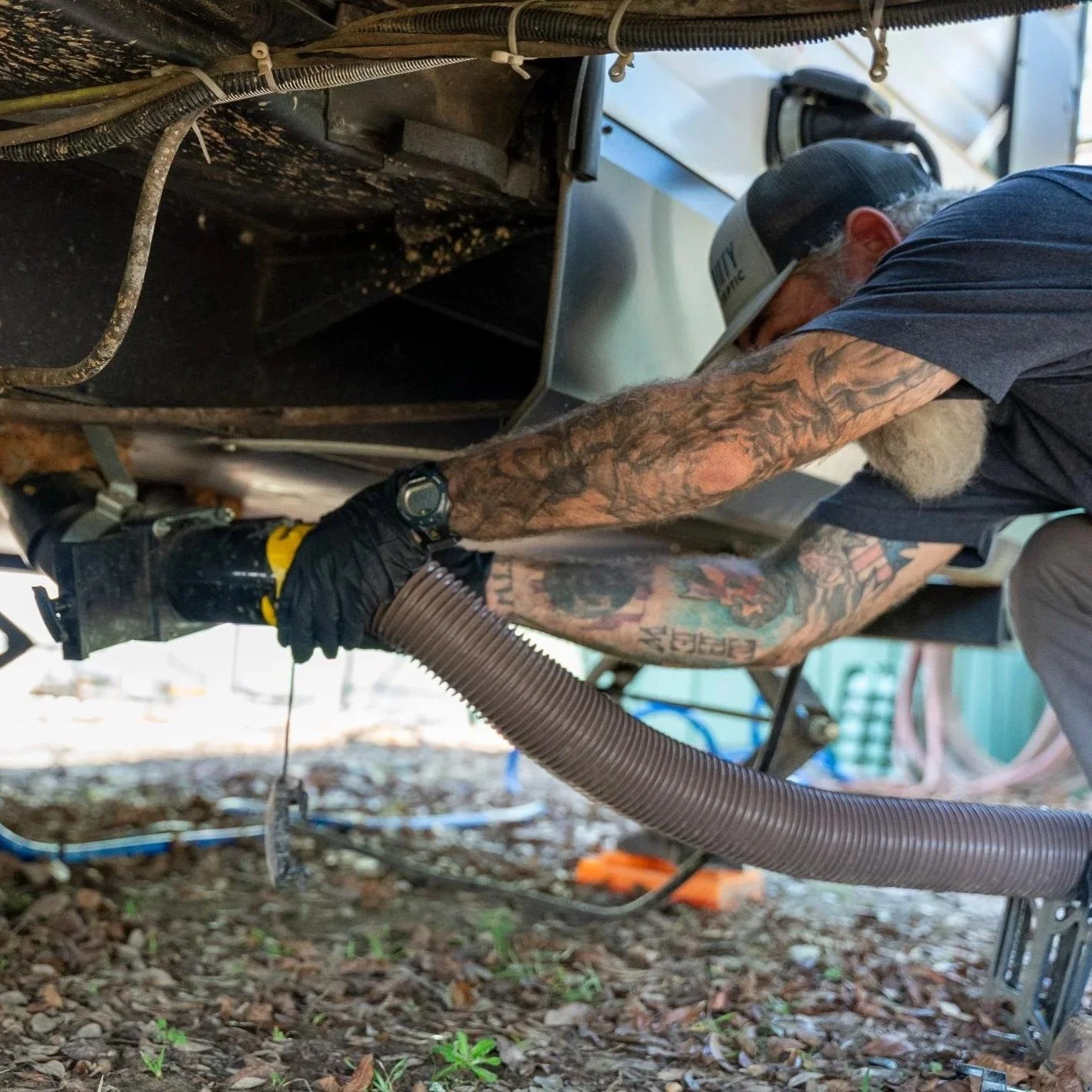
Technician connecting hose to lift station outlet, performing pumping service to maintain wastewater flow and prevent system backups.
Understanding What a Lift Station Does Within a Wastewater System
A lift station exists to solve a problem that gravity alone cannot handle. Wastewater normally relies on slope to move from buildings to treatment or disposal points. When terrain, distance, or system layout prevents continuous downhill flow, a lift station takes over. It collects wastewater in a basin and uses pumps to move that wastewater upward or across elevations so gravity can resume its job downstream. Without lift stations, many properties could not move wastewater reliably from point A to point B.
Lift stations appear in residential developments, commercial facilities, industrial sites, and municipal infrastructure. Whenever plumbing fixtures are lower than the next available sewer main or treatment component, lift stations are required. Their role often goes unnoticed because they operate automatically in the background. When functioning properly, wastewater flow feels seamless. When lift station pumping is neglected, that invisible role becomes very visible very quickly through backups, alarms, and operational failures that disrupt entire systems rather than isolated fixtures.
Why Lift Station Pumping Directly Controls System Reliability
Lift station pumping determines whether wastewater continues moving or comes to a stop. Pumps inside the station cycle on and off based on liquid levels. As wastewater enters the basin, levels rise until pumps activate and move the volume onward. Over time, solids, grease, grit, and debris settle to the bottom of the basin. If pumping does not remove those materials at appropriate intervals, pumps lose efficiency, floats stick, and capacity diminishes. Flow becomes unpredictable even though upstream plumbing remains unchanged.
Reliability depends on maintaining clear operating conditions inside the station. Accumulated solids interfere with pump impellers and reduce effective basin volume. Wastewater reaches trigger levels faster, causing pumps to cycle more frequently under higher strain. Without regular lift station pumping, systems operate closer to failure thresholds every day. What once handled routine fluctuations easily begins reacting poorly to normal use patterns, making reliability dependent on luck rather than design.
How Solids Accumulation Disrupts Wastewater Movement
Wastewater carries more than liquid. Paper products, organic waste, grease, sand, and other debris travel through the system and eventually reach the lift station basin. Gravity allows much of that material to settle. Over time, solids form layers that reduce storage capacity and obstruct pump intakes. Lift station pumping removes the accumulated material before it interferes with mechanical operation.
When solids remain in place, pumps pull wastewater unevenly. Some material circulates repeatedly rather than exiting the system. That recirculation accelerates wear and creates blockages downstream. Flow slows even though the pumps appear operational. Wastewater movement becomes inconsistent, with sudden surges followed by stagnation. Removing solids through routine pumping restores predictable flow patterns and protects mechanical components from unnecessary stress.
Why Lift Station Failures Cause Widespread Consequences
Lift station failure rarely affects a single fixture. Because stations serve as collection points, failure impacts everything upstream. Wastewater backs up into multiple buildings or service lines simultaneously. Alarms may activate, but by the time alerts receive attention, wastewater has often already reached unacceptable levels. Lift station pumping reduces the likelihood of these cascading failures by maintaining functional capacity before emergencies develop.
The consequences extend beyond plumbing inconvenience. Overflowing lift stations release untreated wastewater into the environment or interior spaces. Health risks escalate quickly, especially in commercial or public settings. Cleanup requirements multiply because contamination spreads across larger areas. Preventing these outcomes hinges on proactive pumping that keeps stations operating within safe margins, rather than reacting after failure.
The Mechanical Stress Caused by Infrequent Pumping
Pumps inside lift stations operate under demanding conditions, even in ideal circumstances. They handle variable flow, suspended solids, and frequent start-stop cycles. When pumping intervals stretch too far apart, mechanical stress increases dramatically. Solids accumulate around impellers, increasing resistance. Motors work harder to move the same volume of wastewater. Heat buildup accelerates wear and shortens service life.
Electrical components also suffer. Floats and sensors stick when debris accumulates. Pumps cycle erratically, turning on and off more often than designed. Control panels experience increased load fluctuations. Lift station pumping reduces these stresses by restoring clean operating conditions that allow equipment to perform within design parameters. Mechanical longevity depends as much on waste removal as on the quality of the equipment itself.
How Grease and Fats Complicate Lift Station Performance
Grease presents a unique challenge for lift stations. Fats and oils enter wastewater systems from kitchens, food service operations, and even residential sources. As grease cools, it solidifies and adheres to basin walls, pumps, and piping. Over time, grease layers reduce effective volume and restrict flow paths. Lift station pumping removes these accumulations before they harden into thick deposits that are difficult to remove.
Grease buildup interferes with pump efficiency and sensor accuracy. Floats may fail to register actual liquid levels when coated with grease. Pumps draw uneven loads as grease clogs intake areas. Flow slows downstream even when the pumps are running. Regular lift station pumping prevents grease from becoming a structural problem rather than a maintenance issue. Addressing grease early protects both mechanical performance and system reliability.
Why Lift Station Pumping Supports Downstream Infrastructure
Lift stations do not operate in isolation. Everything that passes through them continues downstream to force mains, gravity lines, treatment systems, or disposal fields. When lift stations fail to remove solids adequately, those materials migrate into downstream components. Pipes clog, valves stick, and treatment systems operate less efficiently. Lift station pumping acts as a control point that protects the rest of the system.
Downstream repairs often cost far more than lift station maintenance. Force main cleaning, pipe replacement, and treatment system rehabilitation disrupt operations and budgets. Maintaining clean conditions at the lift station reduces particulate loading throughout the system. Protecting downstream infrastructure begins at the collection point, not at the point of failure.
The Role of Pumping in Managing Peak Flow Events
Wastewater flow rarely remains constant. Morning routines, business hours, events, and weather conditions create surges that challenge system capacity. Lift stations rely on available basin volume to absorb those peaks before pumps move wastewater onward. Accumulated solids reduce that buffer. Peak flows overwhelm stations faster, triggering alarms or overflows.
Lift station pumping restores usable storage volume, allowing systems to manage variability. With adequate capacity, pumps cycle predictably and recover quickly after surges. Without pumping, every peak event becomes a stress test. Managing peak flow depends less on pump size than on maintaining the space those pumps need to operate effectively.
Why Monitoring Alone Cannot Replace Lift Station Pumping
Alarms, sensors, and monitoring systems play an important role in lift station management, but they do not remove waste. Monitoring reports conditions. Pumping corrects them. Relying on alarms without regular pumping assumes perfect response times and ideal conditions. In reality, alerts may occur during off-hours or after capacity has already been compromised.
Monitoring works best as a supplement to routine pumping rather than a substitute for it. Clean basins produce more accurate sensor readings. Pumps respond more predictably. Alarms become early warnings rather than emergency notifications. Lift station pumping reduces dependence on reactive monitoring and supports proactive system management.
How Infrequent Pumping Increases Emergency Risk
Emergency lift station service is often due to deferred pumping rather than sudden failure. As solids accumulate, the margin for error shrinks. A single power interruption, mechanical fault, or usage surge triggers overflow. Emergency responses involve higher costs, rushed decisions, and increased safety risks.
Routine lift station pumping reduces emergency frequency by addressing known accumulation patterns before they escalate into crisis conditions. Planned service allows coordination, safe access, and thorough inspection. Emergency pumping addresses symptoms under pressure. Preventing emergencies depends on maintaining capacity rather than reacting to alarms.
Environmental and Regulatory Implications of Poor Lift Station Maintenance
Lift station overflows release untreated wastewater directly into the environment. Surface water contamination, soil saturation, and groundwater exposure carry serious consequences. Regulatory agencies impose strict penalties for releases associated with inadequate maintenance. Lift station pumping supports compliance by preventing conditions that lead to overflow.
Documentation of pumping and maintenance activities often forms part of regulatory oversight. Consistent records demonstrate responsible operation and risk management. Environmental protection begins with preventing uncontrolled discharge. Lift station pumping represents one of the most direct actions operators can take to reduce environmental risk.
The Financial Case for Routine Lift Station Pumping
Routine lift station pumping is a predictable operational expense. Emergency repairs, environmental cleanup, and equipment replacement often entail unpredictable and often much higher costs. Systems that receive consistent pumping experience longer equipment life, fewer service interruptions, and lower total ownership cost.
Financial planning improves when pumping schedules align with actual accumulation rates. Budgeting becomes proactive rather than reactive. Lift station pumping supports financial stability by replacing crisis-driven spending with controlled maintenance investment.
How Pumping Supports Inspection and Long-Term Planning
Lift station pumping creates opportunities for inspection that would not otherwise exist. Clean basins enable technicians to accurately assess pump condition, structural integrity, and sensor performance. Early identification of wear or damage supports planned repairs rather than emergency replacements.
Inspection data collected during pumping visits inform long-term planning. Trends in accumulation, grease presence, or debris type reveal upstream behavior that may require adjustment. Pumping supports system understanding, not just waste removal.
Why Lift Station Pumping Is a Core Part of Wastewater Flow Management
Wastewater flow depends on uninterrupted movement from source to destination. Lift stations serve as critical transition points in that journey. When pumping maintains clear operating conditions, flow remains consistent and predictable. When pumping gets neglected, flow becomes erratic, reactive, and vulnerable to failure.
Lift station pumping keeps wastewater moving when gravity cannot. It protects equipment, downstream infrastructure, environmental health, and operational continuity. Flow management relies on capacity, not hope. Pumping provides that capacity.
FAQs
Heavy Duty Pumping & Septic offers reliable and lasting solutions for professional commercial and industrial pumping and septic services, including lift station & pump system services, grease trap services, commercial septic pumping, and industrial waste pumping. Our experienced team, with over 35 years in the industry experience, has the latest pumping equipment and focus on preventing backups, maintaining efficient flow, and ensuring long-term system performance. Call today and secure efficient, uninterrupted operation for your business.
