Quick Answer: A septic system treats wastewater in two stages. Everything you flush or drain flows to a buried septic tank, where solids settle into sludge, grease floats as scum, and bacteria break down the waste. The clarified liquid in the middle, called effluent, flows out to a drain field, where soil filters it before it reaches groundwater. Pumping removes the sludge that bacteria cannot fully digest.
If you have a septic system, everything that leaves your house through a drain ends up in the same place, and most homeowners have never seen it. There is no city sewer main carrying it away. Instead, a buried tank and a patch of your own yard quietly treat every gallon and return the clean water to the ground. Knowing the path that water takes, tank first and then field, makes it obvious why some habits protect the system and others wreck it.
The Two-Stage Path Every Drop Takes
A septic system is really two treatment steps working in sequence. The tank handles the first stage, separating and partly digesting the waste. The drain field handles the second, using soil to finish the cleaning. Water always moves in that order: house to tank, tank to field, field to groundwater. Nothing skips a step.
That sequence matters because each stage depends on the one before it. If the tank stops separating solids properly, those solids move into the drain field and clog it. A drain field that clogs cannot be pumped clean the way a tank can, and replacing one is the most expensive repair a septic owner faces. Protecting the field starts with understanding what the tank is supposed to do first.
Inside the Septic Tank
The tank is a watertight box, usually concrete, sitting a few feet underground between your house and the drain field. A single pipe brings wastewater in from the home, and a single pipe carries treated liquid out toward the field. Most residential tanks hold somewhere between 1,000 and 1,500 gallons, sized to the number of bedrooms in the house.
Three layers form inside
Once wastewater sits still in the tank, it sorts itself by weight. Heavy material, food particles, and waste sink to the bottom and become a layer called sludge. Lighter material, fats, oils, and grease, rises to the top and forms a crust called scum. Between them sits a middle layer of relatively clear liquid, the effluent, and that is the only layer meant to leave the tank.
Baffles keep the layers in place
At the inlet and outlet you will find baffles, sometimes shaped as simple T-fittings called tees. The inlet baffle directs incoming water downward so it does not stir up the settled layers or push the scum around. The outlet baffle reaches below the scum layer and draws liquid only from the clear middle band, which stops floating grease and settled solids from escaping into the drain field. A missing or broken outlet baffle is one of the quiet ways solids reach a field and ruin it.
Two compartments do the work better
Many modern tanks are divided into two compartments by an interior wall with a passage between them. The first compartment does most of the settling and holds the bulk of the sludge. The second gives the liquid more still time to let finer particles drop out before it flows to the outlet. The result is cleaner effluent leaving the tank than a single chamber would produce.
Why the Bacteria Matter
A septic tank is not just a holding box. It is a living digester. Naturally occurring anaerobic bacteria, the kind that thrive without oxygen, live in the sludge and scum and constantly break down the organic matter. They reduce the volume of solids, turn much of the waste into liquid and gas, and are the reason a tank does not fill with solids in a matter of months.
Those bacteria are hardy, but they are not indestructible. Regularly pouring chlorine bleach, drain cleaners, paint thinners, or other harsh chemicals down the drain kills them off faster than the tank can rebuild the colony. Large quantities of antibiotics passing through the system can do the same. A household on a course of medication will not usually harm the tank, but dumping unused pills or flushing large volumes of disinfectant is a different matter. When the bacterial population crashes, solids stop breaking down, sludge builds faster, and more of it slips toward the field.
Think of the bacteria as a small crew working a slow shift: give them a steady, ordinary workload, and they keep pace for years, but flood them with poison and the whole operation stalls. You do not need to buy additive products to feed them. A normal household provides everything the colony needs.
Where the Effluent Goes: The Drain Field
When new wastewater enters the tank, it displaces an equal amount of effluent out the outlet baffle. That liquid flows to the drain field, also called the leach field or absorption field. This is the second treatment stage, where the water actually gets clean.
Leach lines spread the flow
The drain field is a set of parallel trenches, the leach lines, buried in the yard. Each trench holds a perforated pipe surrounded by gravel or a manufactured chamber. Effluent trickles out through the perforations and spreads across a wide area of soil rather than dumping in one spot. Spreading the load keeps any single patch of ground from flooding.
Soil finishes the treatment
The soil beneath the trenches is the real filter. As effluent percolates down, a biological mat of microbes forms in the top layer of soil and consumes the remaining organic matter, viruses, and bacteria. The soil physically strains out fine particles while these microbes handle the biology. By the time the water passes several feet down through suitable soil, it is clean enough to rejoin the groundwater safely. Coarse sandy soil drains quickly but treats less thoroughly, while dense clay treats well but drains slowly, which is why soil type dictates how a field is designed and sized.
Why Pumping Is Still Necessary
If bacteria break down the waste, a fair question is why the tank ever needs pumping. The answer is that the bacteria do not digest everything. A fraction of what enters- mineral grit, some fibers, and the tougher solids- cannot be broken down and simply accumulates as sludge on the bottom and scum on top. That inert material builds up year after year no matter how healthy the bacteria are.
As those layers grow, the clear middle band shrinks. Eventually sludge rises close to the outlet baffle, and solids that should stay in the tank start washing out to the drain field, where they clog the soil pores permanently. Pumping removes the accumulated sludge and scum before that happens, resetting the tank so the separation process has room to work again. Pumping and inspection are jobs for a professional with the right equipment; the schedule depends on tank size and household use, and a technician measuring the sludge depth can tell you where you stand.
Signs the System Is Struggling
Because it all runs underground, trouble usually announces itself indirectly. Watch for these:
- Drains and toilets throughout the house running slow at the same time, not just one fixture
- Gurgling sounds in drains or toilets when water runs elsewhere
- Sewage odors indoors or around the tank and field
- Wet, spongy ground or unusually lush, green grass over the drain field
- Sewage backing up into the lowest drains in the house
Any of these points to a system that cannot move or treat water the way it should, and the cause could be a full tank, a failing field, or a blockage. It is worth a professional look before a slow problem becomes a backup.
Habits That Protect the Whole System
The system lasts longest when you respect its limits. Two ideas cover most of it: control the water and control what goes in.
Go easy on water volume: Every gallon you send down eventually has to pass through the drain field. Overloading the system, running back-to-back laundry loads, or leaving a fixture leaking gives the effluent no time to settle in the tank and floods the field faster than soil can absorb. Spreading laundry across the week and fixing leaks keeps the flow steady.
Keep grease and solids out: Cooking grease that hardens in the tank thickens the scum layer and can travel into the field. So-called flushable wipes do not break down like toilet paper and instead pile up in the tank. Coffee grounds, feminine products, paper towels, and cat litter belong in the trash, not the drain. The less non-digestible material you send in, the slower the sludge builds and the longer you go between pump-outs.
Finally, treat the drain field as off-limits above ground. Do not park vehicles, drive equipment, or build structures over it. The weight compacts the soil and crushes the leach lines, and roots from trees planted too close will invade and block the pipes.
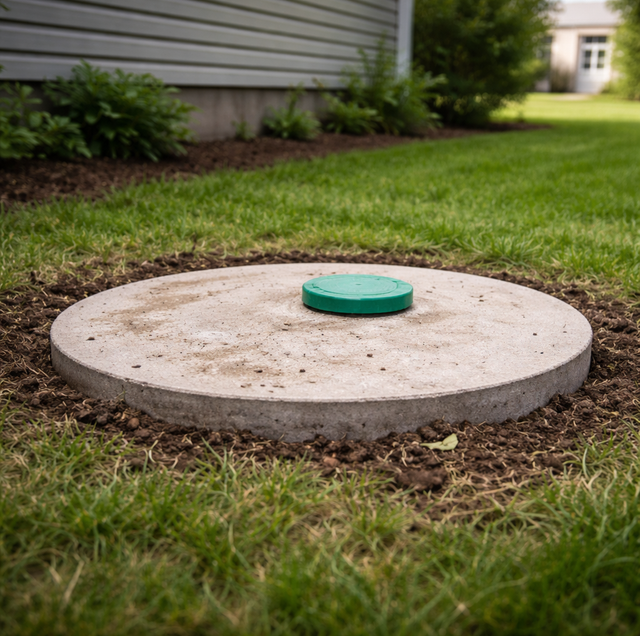
Never open, lean into, or enter a septic tank. The gases inside can displace oxygen and knock a person out in seconds, and the liquid depth is a drowning hazard. Tank lids, especially older concrete ones, can crack and give way, so keep children and vehicles off them.
Frequently Asked Questions
A well-maintained tank made of concrete commonly lasts 30 to 40 years, and the drain field often 20 to 30, though the field is the more fragile half. What shortens either dramatically is neglect: an unpumped tank that sends solids into the field can clog it in a fraction of that time. The single biggest factor in longevity is keeping solids in the tank where they belong.
If your system relies entirely on gravity, yes, it keeps working through an outage because no electricity is involved. Systems with a pump or lift station are different, because the pump cannot run without power and the holding basin will fill. During an extended outage on a pumped system, minimize water use until power returns to avoid overflowing the basin.
Shallow-rooted grass over the field is fine and actually helps by taking up moisture. Vegetable gardens are discouraged, because effluent has not fully finished treatment at the trench level and edible crops can pick up bacteria. Trees and shrubs are the real danger, since their roots seek out the moisture and nutrients in the lines and will grow into and crack the pipes.
No. The bacteria a healthy household needs already arrive naturally in the waste stream, so store-bought additives are unnecessary, and none of them digest the inert grit and mineral solids that make up sludge. Since that inert layer is exactly what pumping removes, no additive can substitute for a physical pump-out.
A conventional tank is anaerobic, relying on bacteria that work without oxygen and produce a slower, gassier breakdown. An aerobic treatment unit adds an air pump that injects oxygen, so oxygen-loving bacteria digest waste faster and produce cleaner effluent. Aerobic units treat more thoroughly but have moving parts, use electricity, and need more frequent servicing than a passive tank.
Field size is designed around estimated daily flow, often roughly 100 to 150 gallons per bedroom per day, which is why the tank is sized by bedroom count rather than square footage. A sudden spike, such as a large party or several house guests, can briefly overwhelm the field's absorption rate even on a healthy system, which is why spreading heavy water use across days protects it.
Book a septic pump-out or inspection before small problems become backups — protect your tank, field, and groundwater with a crew that has done it since 1988. Heavy Duty Pumping & Septic serves Lucedale, Pascagoula, and the Gulf Coast. Call (601) 804-2230.
