
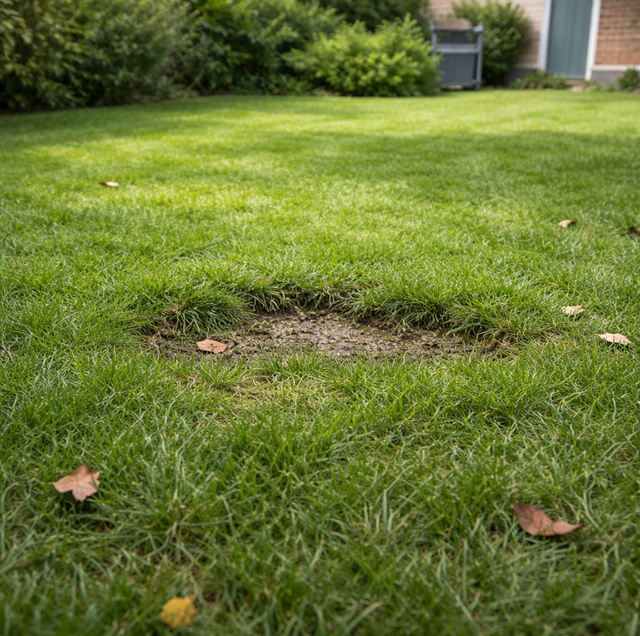
Quick Answer: A cracked or damaged septic tank shows up as a level that never reads right (constantly full or draining down to empty between pumpings), soggy or unusually green grass over the tank, a depression or sinkhole in the yard, sewage odor near the tank, slow drains or backups, and a tank that needs pumping far more often than it used to. Any of these means the shell has lost its seal. Stop treating the yard as normal ground, keep people and vehicles off the tank, and have a professional inspect it.
A septic tank is supposed to be one thing above all else: watertight. It holds sewage while solids settle to the bottom and lighter scum floats to the top, then it lets only the clarified middle layer flow out to the drain field. The moment the shell cracks or a fitting breaks, that balance falls apart. Water it should keep in gets out, or groundwater that should stay out gets in, and the whole system starts working against itself.
The trouble is that a tank sits buried, out of sight, doing its job silently for years. Damage rarely announces itself. It shows up instead as small oddities in the yard and the drains that are easy to explain away one at a time. Knowing how a tank fails, and what those oddities add up to, is what lets you catch a crack before it becomes a flooded drain field or a contaminated yard.
How a Septic Tank Gets Damaged
Tanks are built to last decades, but nothing buried in wet, shifting ground lasts forever. The way a tank fails depends heavily on what it is made of and what has been happening above and around it.
Age and corrosion in steel tanks: Older properties often have steel tanks, and steel has a hard ceiling on its lifespan. The metal rusts from the inside, where sewer gases form corrosive acids, and from the outside, where damp soil chews at it year after year. The top of the tank and the baffles usually go first, thinning until they flake and give way. A steel tank that has been in the ground for thirty or forty years is often rusting through whether or not anyone can see it, and once the shell is compromised, there is no patching it back to watertight.
Concrete cracking and separation: Concrete tanks are the common choice today, and they are tough, but they are not immune. Ground that swells when wet and shrinks when dry puts steady pressure on the walls. Settling soil can drop one end of the tank relative to the other and open a crack along a seam. Concrete can also spall and weaken over decades of contact with the acidic gases inside. A hairline crack that weeps is a slow problem; a cracked seam between the lid and the body is a fast one.
Roots, vehicle loads, and settling: Tree and shrub roots hunt for the moisture and nutrients a tank offers, and they exploit any small opening, prying a minor crack into a major one over a few seasons. Weight from above is just as damaging. A tank lid and shell are engineered for the load of soil, not for a truck, a trailer, or a loaded delivery van parked on top. Driving or parking over a tank can crack the lid or collapse the top outright. Uneven settling, where the soil under one corner compacts more than the rest, twists the box and finds its weakest joint.
Broken baffles, tees, and lids: Not all damage is a crack in the wall. The inlet and outlet baffles (also called tees) are the internal fittings that force incoming waste downward and keep floating scum from escaping to the drain field. When a baffle corrodes off, breaks, or falls into the tank, solids and scum wash straight out to the drain field and clog it, even though the tank shell is intact. A cracked or crumbling lid is its own hazard, both because it lets surface water pour in and because it can give way underfoot.
Why a Damaged Tank Matters
A crack breaks the one rule a septic tank has to keep, and it fails in two directions at once.
When the tank sits below the water table or fills with rain-soaked soil moisture, groundwater leaks *in*. That extra water floods the tank, shortens the time solids have to settle, and pushes far more liquid out to the drain field than it was sized to absorb. The field stays saturated, drains slow down, and the whole system edges toward backing up. A tank that suddenly needs pumping twice as often is frequently a tank taking on groundwater through a crack.
When the tank sits above the water table, effluent leaks *out*. Raw or partly treated sewage seeps into the surrounding soil instead of flowing through the drain field, where it is supposed to be filtered. That untreated wastewater carries bacteria and nitrogen straight into the ground and, from there, toward wells and surface water. It is both an environmental problem and a health hazard, and it is the reason a leaking tank is treated as urgent rather than cosmetic.
Warning Signs of a Cracked or Damaged Tank
No single sign is proof on its own. Read them together, and a pattern usually points straight at the tank.
The level is never right: A healthy tank holds a fairly steady liquid level, up to the bottom of the outlet. If a professional opens it and finds it nearly empty between pumpings, the tank is leaking effluent out through a crack. If it reads constantly full or overfull, water is either coming in through a breach or failing to flow out. Both readings mean the seal is broken somewhere.
Sudden lush or soggy grass: Grass over a leaking tank often turns a deep, vivid green and grows faster than the rest of the yard, fed by the nutrients in escaping effluent. The ground may also stay spongy or wet long after any rain has drained elsewhere. A patch that is greener and wetter than everything around it, in the same spot year after year, is a classic tell.
A depression or sinkhole over the tank: When a lid cracks or a shell partly collapses, the soil above loses its support and sinks. A shallow dip, a soft spot, or an outright sinkhole appearing over the buried tank means the structure below has failed and dirt is falling into the void. This one deserves immediate caution, because the ground there can no longer be trusted to hold weight.
Sewage odor near the yard: A properly sealed system vents through the roof, not the yard. A persistent sewage smell around the tank or drain field means gases and liquids are escaping where they should be contained, often through a cracked lid or a breached wall.
Slow drains and backups: Drains throughout the house that gurgle, run slow, or back up can point to a tank that is flooded with groundwater or one whose broken baffle has let solids clog the outlet and the field. When several fixtures slow down together, the problem is usually at the tank, not the individual drain.
Pumping far more often than before: A tank on a normal household schedule holds its interval for years. If the interval keeps shrinking, and it needs pumping in months instead of years, something is adding water to the tank that does not belong there. Groundwater entering through a crack is one of the most common culprits.
How a Damaged Tank Is Inspected
Confirming a crack is a job for a professional with the right tools, and it is not something to attempt by opening the tank yourself. A technician typically starts with a water-level check, reading where the liquid sits relative to the outlet after the tank has had time to stabilize. A level that has dropped points to a leak out; a level riding high points to water coming in or a blocked outlet.
From there, a dye test can trace where water is going. Dye introduced into the system and later spotted at the surface or in nearby water confirms effluent is escaping. For a direct look, a camera inspection sends a waterproof video probe into the tank and lines to reveal cracks, corroded baffles, root intrusion, and separated seams without excavation. Together, these methods locate the breach and show whether it is a repairable fitting or a failed shell.
Repair Versus Replacement
Some damage is fixable in place. A broken or missing baffle can often be replaced with a modern sanitary tee. A cracked concrete lid can be swapped for a new one. Minor cracks in an otherwise sound concrete tank can sometimes be sealed if they are caught early and the structure is still solid.
A corroded steel tank is a different story. Once steel has rusted through, sealing it is a temporary patch at best, because the rest of the shell is corroding on the same timeline. In most cases, a rusted-out steel tank needs full replacement, usually with a modern concrete or plastic tank that will not corrode the same way. A concrete tank with a collapsed top or a major structural crack across the shell usually needs replacement as well. The deciding factor is whether the shell can be made watertight again and stay that way, which is exactly what an inspection is meant to determine.
Never enter or lean into a septic tank. The gases inside are toxic and can incapacitate a person in seconds, and the liquid is a drowning risk even in a shallow tank. A cracked or aging lid can collapse under the weight of a person standing on it, which is why children, pets, and vehicles must be kept off the area over the tank entirely. Inspection, repair, and replacement are professional work. If any digging is planned near the tank or field, call to have underground utilities located first.
Frequently Asked Questions
A well-built concrete tank commonly lasts around 40 years, though the outlet baffle and access risers often need attention sooner. Tanks set in expansive clay or subjected to repeated heavy loads above them can crack decades earlier, while one in stable, well-drained soil may outlive that estimate. Steel tanks, by contrast, are usually near the end of their service life by 20 to 25 years.
Ground movement stresses a tank in every season, not just one. A saturated wet season swells clay soils and lifts the water table, pressing on the walls, while a dry stretch shrinks the soil away and drops support unevenly. In colder snaps, frost heave nudges shallow tanks and risers. The steady, year-round strains of settling, corrosion, and root pressure do far more cumulative damage than any single weather event.
No. Poured-in bacterial or chemical additives do nothing for a structural crack, and some accelerate corrosion in steel tanks. A crack is a physical breach that has to be sealed from the tank itself or the tank replaced. Any product promising to "repair" a leak from inside without an inspection should be treated with skepticism rather than trust.
A leaking tank loses or gains water through its own shell or fittings; a failing drain field can no longer absorb the effluent the tank sends it. They produce overlapping symptoms, like soggy ground and slow drains, but the fix is different. A camera and dye inspection distinguishes them by showing whether water is escaping at the tank or ponding out in the field, which is why guessing between them wastes money.
Reduce water use as much as you reasonably can. Every gallon that goes down the drain reaches a compromised tank and can push more untreated effluent into the soil or worsen a backup. Spreading out laundry, shortening showers, and fixing any running toilet buys time and limits contamination until a technician arrives. If sewage is already backing up indoors, stop using water entirely.
Coverage is narrow and depends on cause. Most standard policies exclude damage from gradual wear, corrosion, or root intrusion, treating those as maintenance rather than sudden accidents, so an old steel tank rusting through is typically not covered. A tank crushed by a covered event may be a different matter. Reading the policy's language on "wear and tear" versus "sudden and accidental" damage is the place to confirm before assuming either way.
Get a cracked tank inspected before it floods your yard — a camera and dye check finds the breach fast. Heavy Duty Pumping & Septic LLC serves Lucedale, Leakesville, Hurley, MS. Call (601) 804-2230.
