The drain field is where a septic system does its final and most important job, yet it is the part homeowners understand the least. Everything that leaves the tank as liquid ends up here, spread through a network of perforated pipes bedded in gravel and released slowly into the soil. When it works, you never think about it. When it fails, the repair is usually the largest one a septic system will ever hand you, because a truly failed field often cannot be patched: it has to be dug up and rebuilt. Understanding what wears a field out is the first step to keeping yours out of that category.
How a Healthy Drain Field Is Supposed to Work
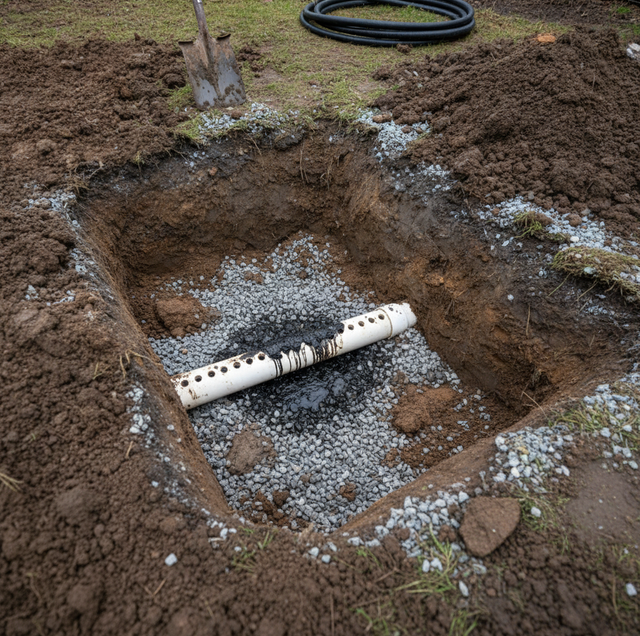
Also called a leach field or absorption field, the drain field takes the clarified liquid, known as effluent, that flows out of the septic tank and disperses it underground. Perforated distribution pipes carry that effluent across a bed of gravel or crushed stone, and from there it trickles down into the surrounding soil. The soil itself is the treatment plant: as effluent seeps through it, natural bacteria and the layers of earth filter out remaining contaminants before the water rejoins the groundwater.
The engine of that treatment is a thin biological layer called the biomat. It forms naturally at the interface where effluent meets soil, a living mat of bacteria that digests the organic material in the wastewater. A healthy biomat does most of the actual cleaning. Trouble starts when it grows too thick and dense, because a choked biomat stops water from passing through. The field can no longer absorb what the tank sends, and the system begins to back up behind it.
Too Much Water: Hydraulic Overload
The single most common way to overwhelm a drain field is simply sending it more water than it was designed to absorb. This is called hydraulic overload. Every field is sized for a certain daily volume based on the household and the soil's absorption rate. Run well past that, and the soil stays saturated, never getting a chance to drain and re-aerate between doses.
The usual culprits are ordinary habits stacked up: several loads of laundry run back-to-back, long showers, a leaking or constantly running toilet, or a household that has grown since the system was installed. A running toilet flapper alone can push hundreds of extra gallons into the system unnoticed in a day. Constant saturation also feeds biomat overgrowth, so hydraulic overload rarely stands alone for long: it accelerates the clogging that finishes off a field.
Solids Carryover From a Tank That Was Not Pumped
A septic tank works by allowing solids to settle to the bottom as sludge and grease to float to the top as scum, leaving the relatively clear effluent in the middle to flow out to the field. That separation only holds up if the tank is pumped on schedule. Let the sludge layer build too high, and solids get carried out with the effluent and into the distribution pipes.
Once solids reach the field, they do damage water never could: they clog the pipe perforations, plug the gravel bed, and seal off the soil pores meant to absorb the liquid. That clogging is often permanent, because you cannot easily flush fine solids back out of packed soil. This is why skipping tank pumping is the most preventable cause of failure: the maintenance task people delay is the one that most directly kills the field.
Grease, Chemicals, and Things That Should Not Go Down the Drain
Fats, oils, and grease poured down the kitchen sink do not break down the way normal waste does. They congeal, ride along with the scum layer, and eventually contribute to solids carrying into the field and coating the soil. Non-flushable items, such as wipes labeled as flushable, paper towels, feminine products, and coffee grounds, increase the sludge load and accelerate how quickly the tank fills.
Harsh chemicals cause quieter harm. Large volumes of bleach, drain cleaners, solvents, and antibacterial products kill the bacteria the system depends on, in the tank and the biomat alike. Knock out that population and the biological treatment stalls, leaving the field to handle waste it was never meant to process alone.
Compaction From Traffic and Structures Overhead
Soil needs air pockets to absorb and treat effluent, and those pockets are fragile. Driving or parking vehicles over the drain field, running heavy equipment across it, or building a shed, patio, or addition on top of it compresses the soil and closes those pockets. Compacted soil cannot absorb water the way loose soil can.
The pressure also threatens the buried pipes. Distribution lines and gravel sit fairly shallow, and the weight of a truck or a slab can crack or crush them, collapsing the very channels that carry effluent out. That is why the area over a field should stay planted in grass and nothing else, no driveways, no storage, no structures.
Roots, Saturated Soil, and Age
Tree and shrub roots are drawn to the moisture and nutrients in a drain field, and they will grow straight into the distribution pipes in search of them. Once inside, roots form dense masses that block flow and pry pipe joints apart. Trees planted too close to the field, or a field installed too near existing trees, sets this problem in motion years before it shows.
Then there is the ground itself. A high water table or a stretch of unusually heavy rain saturates the soil from below and around the field, and soil that is already full of water has nowhere to put the effluent. The reverse holds too: a field on well-drained ground in a dry spell has plenty of capacity, which is why this is a year-round consideration rather than a seasonal one: the water table rises and falls with the weather in every month. Coastal soils and naturally high groundwater make some sites harder on a field from the start. Finally, no field lasts forever. Even a well-kept one gradually accumulates biomat and loses absorption capacity, so age alone eventually retires a field nothing else damaged.
Recognizing the Warning Signs Early
A failing field usually announces itself before it quits. Grass over it that is soggy, spongy underfoot, or a brighter, thicker green than the rest of the yard is a classic early sign: the effluent that should filter down is instead surfacing and fertilizing the lawn. A sewage or sulfur odor around the field or tank means wastewater is not being absorbed. Inside, drains and toilets that run slowly, gurgle, or back up point to a system with nowhere left to send its water. Catching these early is what separates a field that can sometimes be rested and recovered from one that has gone too far to save.
What It Comes Down To
A drain field fails for reasons that almost always trace back to something the household controls: too much water, a tank left unpumped until solids escaped, grease and the wrong items going down the drain, weight crushing the soil and pipes, or roots left to grow into the lines. Only a couple of causes, a high water table and plain age, sit outside your hands, and even those are managed by protecting the field from everything else. The buried, out-of-sight nature of the field is exactly why it gets neglected, and why the small habits that protect it, steady pumping, spread-out water use, and keeping traffic and roots away, are worth far more than any repair after the fact.
Frequently Asked Questions
The biomat is a thin, slimy black layer of bacteria and their byproducts that forms where effluent meets the soil wall and floor of the trenches, typically about a quarter to a half inch thick when healthy. It is not a defect. It is the part of the system that actually completes the treatment of wastewater, breaking down pathogens and organic matter before the water reaches groundwater. The problem is that it grows toward the effluent supply. When it thickens into a dense, greasy layer, often described as anaerobic, it becomes nearly waterproof and suffocates the field's ability to absorb, which sits beneath most field failures.
Because it is the one failure mode you fully control that permanently damages the soil. When sludge is allowed to build up to roughly a third of the tank's depth, the tank loses its settling capacity and pushes solids out of the outlet. Those fine solids migrate into the soil pores of the field and physically plug them, and unlike a water overload, that plugging does not reverse when you fix the habit. Pumping every three to five years for a typical household keeps the sludge low enough that solids never reach the field in the first place, which is why it is the cheapest insurance a septic owner has.
It depends entirely on how far gone it is. A field caught early, stressed but not fully clogged, can sometimes recover if you simply rest it, meaning cut water use dramatically so the soil can dry, re-aerate, and let the biomat thin naturally. Professionals may also try jetting the distribution lines or introducing aeration and bacterial treatments to break down the biomat buildup. But once the soil pores themselves are permanently plugged with solids, or the pipes are crushed, no treatment restores absorption, and the field must be excavated and rebuilt, sometimes on a fresh area of the property entirely.
Two separate ways at once. The weight compacts the soil, collapsing the tiny air pockets the soil needs to absorb and treat effluent, so absorption drops even where the pipes stay intact. At the same time, the distribution pipes and gravel bed sit only a foot or two down, shallow enough that the load of a vehicle, an RV, a pool, or a poured slab can crack or crush them outright. A cracked line stops distributing effluent evenly and can dump it all in one spot, overloading a small section. That is why the standard advice is to keep the field as an open lawn, no parking, no storage buildings, no patios.
The drain field works by gravity: it relies on the ground below being drier than the effluent above, so the water has somewhere to go. When groundwater rises, whether from a naturally high water table common in coastal and low-lying areas or from a stretch of heavy rain, the soil around the trenches is already saturated and cannot accept more water. The field then backs up until the ground drains, which can show as temporary soggy spots or slow drains after storms. Diverting roof downspouts, sump discharge, and surface runoff away from the field is the practical defense, since less water reaching the soil leaves more room for effluent regardless of the season.
A conventional field that is properly sized, installed in suitable soil, and cared for often serves twenty to thirty years or more, though there is no fixed expiration date. What cuts that short is everything covered above: chronic hydraulic overload, missed pumping that sends solids into the soil, grease, root intrusion, and compaction, each of which ages the field faster than time alone would. Two identical fields can differ by decades in lifespan based purely on how the households treated them, which is the strongest argument for conserving water, spreading laundry across the week, and keeping the tank pumped on schedule.
If your yard is soggy, your drains are slow, or you are not sure when the tank was last pumped, a professional look can catch a fixable problem before the field is lost. Heavy Duty Pumping & Septic LLC serves Lucedale, Leakesville, Hurley, and the Gulf Coast. Call (601) 804-2230 to schedule.
