How Coastal Soil and High Water Tables Affect Septic Systems
Quick Answer: Sandy soil near the coast drains fast but filters poorly, and a shallow water table shrinks the buffer of dry soil a drain field needs to treat effluent before it reaches groundwater. Together, those two conditions mean a system has less margin for error, so pumping schedules, field design, and storm-season habits all matter more than they would on a property with deep, well-drained soil.
A septic system doesn't treat wastewater the way a treatment plant does, with tanks, chemicals, and operators monitoring gauges. It relies on soil to finish the job. Bacteria in the tank break down solids, and the liquid that leaves the tank, called effluent, travels to a drain field, where it seeps through soil that filters out pathogens and absorbs nutrients before it rejoins the water cycle. That process depends entirely on having enough of the right kind of soil between the pipe and the water table. Change the soil, or shrink the distance to groundwater, and the entire system behaves differently, even if every pipe and tank was installed correctly.
Why Soil Type Changes How a Drain Field Performs
Soil isn't a passive filter; it's an active part of the treatment process. Clay particles are flat and pack tightly, so water moves through clay slowly, sometimes taking hours to travel an inch. Sand particles are round and leave larger gaps between them, so water moves through sand fast, sometimes covering the same inch in minutes. That percolation rate, how quickly a given soil accepts and passes water, is the single biggest variable in how a drain field is sized and how it performs over time.
Fast percolation sounds like an advantage, and in one narrow sense it is: sandy soil rarely backs up the way dense clay does. But treatment isn't just about moving water through; it's about contact time. Effluent needs to sit in soil long enough for bacteria, viruses, and excess nutrients to be filtered and broken down before that water reaches groundwater. Sand's large pore spaces allow effluent to pass through with less filtering contact than tighter soil provides, which means a sandy field has less natural buffer working in its favor, even when it never floods or ponds.
This is why drain field design leans so heavily on a soil evaluation before the first pipe goes in the ground. A percolation test measures how fast a test hole drains, and that number determines how much field area a system needs. Coarse, sandy soil generally needs a larger field, different pipe spacing, or a different field design than a loam-and-clay mix, because the soil does less of the filtering work on its own.
How a High Water Table Changes the Math
The other variable working against fast-draining soil near the coast is a water table that sits closer to the surface than it does farther inland. The water table is simply the depth at which the ground is fully saturated, and every drain field needs a set amount of unsaturated soil beneath it, sometimes called the vertical separation distance, to filter effluent properly before it can mix with groundwater.
When the water table sits high, that separation shrinks. A field that would have several feet of dry, filtering soil beneath it on a property with a deep water table might only have a foot or two on a property near the coast, especially after rain has pushed groundwater levels up further. Effluent traveling through that thinner buffer gets less filtering time and less distance before it reaches saturated ground, which is exactly the outcome a drain field is designed to prevent.
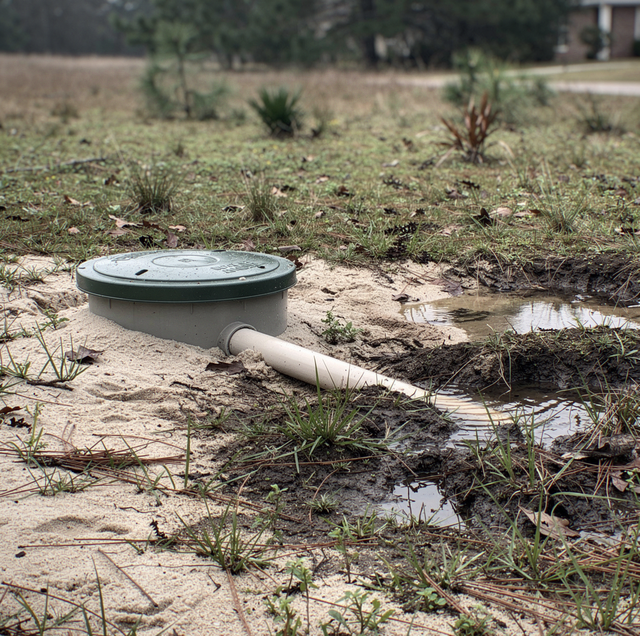
A high water table also changes how a field handles hydraulic loading, meaning the volume of water moving through it at any given time. Soil can only absorb so much water before it reaches capacity, and if the water table sits close to the field, there's less unsaturated soil available to absorb a surge from a full laundry day or a long shower. Once soil is saturated from below and loaded from above, effluent has nowhere to go but back up, showing up as slow drains, a soggy patch over the field, or standing water in low spots in the yard.
What Sandy Coastal Soil and a Shallow Water Table Mean Together
On their own, either fast-draining sand or a shallow water table would call for extra care in system design. Together, they compound in a specific way: sand's speed works against the reduced buffer left by a high water table. Effluent moves through the soil quickly, but there's less soil depth left to filter before it hits saturated ground, so less contact time and less available soil combine to create a system with a much narrower margin for error than a comparable system inland.
This is one of the main reasons drain field failures cluster in certain low-lying spots even when the tanks themselves are sound and pumped on schedule. The tank can be doing its job perfectly, breaking down solids and holding back what it should, and the field can still struggle if the soil beneath it doesn't have the depth or the type needed to finish the treatment process. It isn't a sign of a bad system; the soil and groundwater conditions demand a design built specifically for them, not a generic layout borrowed from different ground.
Storm Season Adds Another Layer of Stress
Rain events push groundwater up temporarily, sometimes by a foot or more within a day or two of a heavy storm, and that rise can bring the water table right up against a drain field that normally has an adequate buffer. During and after a heavy rain, a field that performs fine in dry weather can back up simply because the soil beneath it is already saturated from rainfall soaking down from above, leaving no room to accept effluent from below.
This is also why a drain field can seem to fail overnight rather than gradually. A slow decline in absorption capacity might build for months without showing symptoms, and then a single storm pushes the water table up just enough to tip a marginal field into visible failure: standing water, a sewage smell over the field, or drains that suddenly run slow throughout the house. The storm didn't create the capacity problem; it removed the last bit of buffer the field had left.
Why Pumping Schedules Matter More on These Sites
A septic tank's job is to retain solids so that only clarified liquid reaches the drain field. When a tank isn't pumped often enough, solids and scum build up and eventually carry over into the field, clogging the soil pores that were doing the filtering work. That carryover is a serious problem on any property, but on sandy soil with a shallow water table it's worse, because the field already has less margin, and clogged pores cut the percolation rate right when the field needs it most.
Regular pumping keeps solids from ever reaching the field in the first place, which protects the one variable a homeowner actually controls. Soil type and water table depth are fixed by the property; how often the tank is pumped and how carefully the household manages what goes down the drain are not.
Design Choices That Account for These Conditions
Because soil and water table conditions vary widely from one property to the next, drain field design isn't one-size-fits-all in sandy soils with a shallow water table. A raised or mound-style field can provide usable vertical separation above natural grade when the water table is too close to the surface for a conventional buried field to meet the required depth. Alternative treatment systems, sometimes called aerobic treatment units, add an extra oxygen-based treatment step before effluent ever reaches the field, producing cleaner effluent that asks less of the soil that receives it.
Field sizing itself also shifts. A percolation test on sandy soil often calls for more square footage of field, spread wider rather than deeper, to compensate for the soil's weaker filtering per square foot. These aren't upgrades in the sense of extra features; they're adjustments that match the system to the ground it sits on, much like a foundation design that changes based on the soil beneath a house.
Signs Your Property's Soil and Water Table Are Stressing the System
A few patterns point specifically to soil or water table stress rather than a simple clog or an aging tank:
- Symptoms that track with rainfall: Slow drains or a soggy patch that appears mainly after storms, then improves in dry weather, point toward a water table pushing up temporarily rather than a permanent blockage.
- A field that stays wet longer than the yard around it: If grass over the field holds standing water after the rest of the property has drained, the soil under that specific spot isn't accepting water the way the surrounding ground is.
- Unusually lush or fast-growing grass over the field: Effluent carries nutrients, and grass sitting above a field that's staying saturated near the surface often grows visibly greener and thicker than grass elsewhere in the yard.
- Odor near the field without any odor at the tank: This points to effluent surfacing rather than a tank-side issue, which is a soil or saturation symptom rather than a tank problem.
Any of these patterns is worth a professional inspection rather than a guess, since a field struggling with soil and groundwater conditions needs a different fix than one that simply needs pumping.
What Property Owners Can Actually Control
You can't change the soil beneath your yard or move the water table, but a few habits can reduce the load on a system already operating on a tighter margin. Spacing out heavy water use, rather than running several loads of laundry back-to-back, avoids sending a large hydraulic load through the field all at once. Keeping gutters and downspouts directed away from the drain field prevents roof runoff from adding to the water the soil already has to manage. Avoiding vehicles, sheds, or heavy equipment on the field protects the soil structure that percolation depends on, since compacted soil drains and filters worse than undisturbed soil. And keeping the tank on a pumping schedule matched to household size keeps solids from ever reaching a field with less capacity to spare.
Frequently Asked Questions
Not more frequent, but different. A mound system relies on a pump chamber to distribute effluent evenly across the raised bed, so that the pump and its float switches need periodic checking in addition to the usual tank pumping, since a failed pump stops distribution to the field even if the tank itself is fine.
Soil composition doesn't change quickly, but water table depth can shift over years due to nearby development, drainage changes, or new construction that alters how water moves across a property. A soil test from the original installation still accurately describes the soil type in most cases, but water table behavior is worth reassessing if the surroundings have changed significantly.
Field size is determined by the percolation rate measured at that specific property, not by a standard formula per bedroom. Sandy soil generally requires more field area to compensate for its lower per-square-foot filtering capacity, so two homes of the same size can have very different field footprints once soil conditions are factored in.
Yes, within limits. Grass and shallow-rooted ground cover help draw up excess moisture through evapotranspiration and stabilize the soil surface, which supports percolation. Trees and deep-rooted shrubs are the opposite risk, since their roots seek out the moisture and nutrients in a drain field and can grow into and damage pipes over time.
The risk is higher because sandy soil filters less per foot of travel, so a well sitting too close to a field on coarse soil has a shorter filtering path between the two. This is a major reason why well-and-field separation distances are enforced more strictly where soil and water table conditions reduce natural filtering.
Sometimes, if enough undisturbed ground is available and the water table depth allows it. An expansion needs its own soil evaluation, since adding more of the same pipe in the same soil without changing the design often reproduces the same problem in the new section.
Schedule a septic inspection — find out how your soil and water table are treating your system before a storm reveals a problem. Heavy Duty Pumping & Septic LLC serves Lucedale, Leakesville, Hurley, MS. Call (601) 804-2230.
