Quick Answer: One slow drain usually means a local clog at that fixture. When every drain in the house slows down at the same time, the problem is almost always downstream, where all the plumbing shares a single path: the main sewer line or, on a septic property, the tank or drain field. A full tank or a saturated field can no longer accept water, so the backup travels up through the whole house.
When one sink drains slowly, you reach for a plunger or a hand auger, and the problem stays contained to that fixture. When the kitchen sink, both bathrooms, the tub, and the laundry all slow down within the same week, the plunger is the wrong tool, because nothing is wrong with any single fixture. The trouble is somewhere all of them have in common. Reading which pattern you have is the fastest way to tell a five-minute nuisance apart from a system problem that needs a truck in the driveway.
One Slow Drain Versus the Whole House
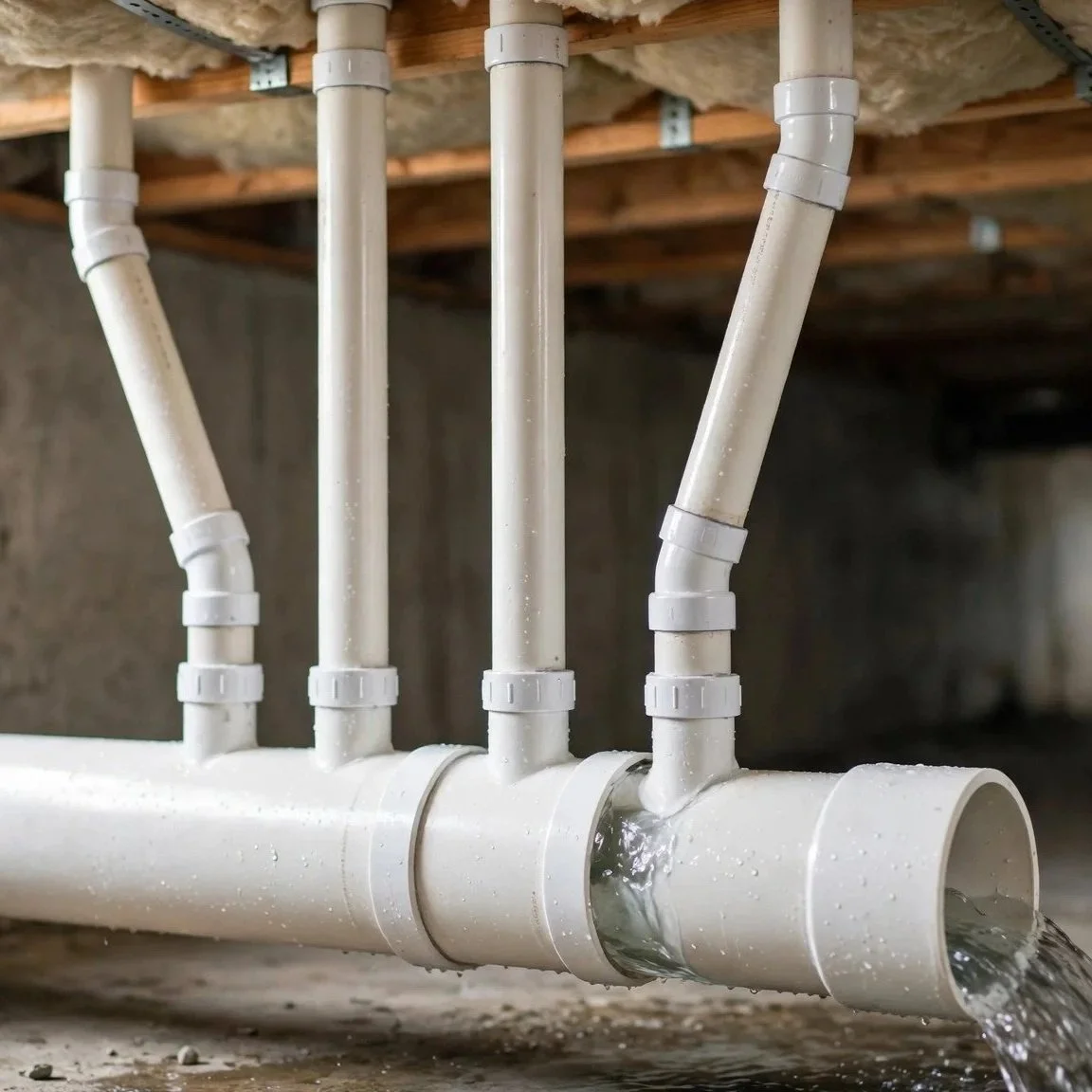
Think of your home's plumbing like the branches of a tree. Each fixture, the kitchen sink, each toilet, the shower, the washing machine, is a small branch. Those branches all feed into progressively larger limbs, and everything eventually joins one trunk: the main line that carries waste out of the house and, on a septic property, into the tank.
If only one branch is blocked, only that fixture backs up. A clog under the kitchen sink is grease and food packed in the P-trap or the branch drain. A slow bathroom sink is hair and soap. These are local, and they stay local, because the water from every other fixture still has a clear path to the trunk.
When the whole house slows at once, the blockage is in the trunk, downstream of where all those branches have already joined. Nothing is wrong with the individual fixtures. They are simply all trying to empty into a shared pipe or a shared tank that can no longer carry the load away. That single distinction, one fixture versus several, is the most useful piece of information you can gather before anyone looks at the system, and it points the entire investigation toward the main line or the septic system rather than at your sinks.
On a Septic Property, "Everything Is Slow" Points at the Tank
For a home on septic, whole-house slow drains are a classic warning sign of a full tank or a system that can no longer move water. The tank is not a holding container that simply fills to the top. It works by separation: solids sink to the bottom as sludge, grease and lighter material float as a scum layer, and the relatively clear liquid in the middle, the effluent, flows out through an outlet to the drain field.
That outlet sits partway up the tank wall by design. When a tank goes years without pumping, the sludge layer on the bottom keeps building until it rises to the level of the outlet. Once solids reach the outlet, effluent can no longer leave the tank cleanly. Liquid backs up behind the blockage, the tank stays full to the brim, and there is nowhere for the next flush or load of laundry to go. The backup climbs the main line, and every drain in the house slows to a crawl, usually with gurgling and a faint sewage odor as the trapped gases look for a way out.
The other septic culprit is a drain field that has stopped accepting water. Even with a healthy tank, if the field cannot absorb effluent, the tank fills, and the same whole-house slowdown follows. A field fails to drain when the soil around it is saturated, when the biomat (the natural bacterial layer at the soil interface) has grown too dense and sealed the ground, or when a high water table has raised the groundwater up into the trench. In areas with a high water table, that last factor is not rare. Low-lying ground and a naturally high water table mean the soil under a field can already be near capacity, so a field that copes fine most of the time has little reserve when it is stressed.
The Other Suspects: Main Line, Vent, and an Overdue Tank
Not every whole-house slowdown is the septic system itself. A clog in the main sewer line, the pipe running from the house to the tank, produces the same symptoms. Grease that has cooled and hardened, tree roots that have found a pipe joint and grown into a mesh inside it, or a "belly" (a low spot where the line has sagged and settled, collecting standing water and debris) can all choke the main. From inside the house, a main-line clog and a full tank look nearly identical, which is exactly why a camera inspection earns its keep: it shows whether the pipe is blocked or clear before anyone assumes the tank is the problem.
A blocked or failed plumbing vent is a quieter suspect. Every drain system has a vent stack that runs up through the roof to let air in behind the water. That air is what lets drains flow smoothly rather than gurgle. When a vent is blocked by a bird nest, leaves, or ice, drains slow down and gurgle loudly as they pull air backward through the traps instead. Slow plus heavy gurgling, without a full tank, often means the vent.
And sometimes the answer is the simplest one: the tank is just overdue. Most household tanks need pumping every three to five years, depending on tank size and how many people use the system. A tank that has quietly gone eight or ten years without service is running out of working space, and slow drains are the first thing the household notices.
How to Read the Tells Before You Call
A few observations narrow the field quickly, and they are worth gathering because they tell a septic professional where to start.
Watch what happens under volume. If the drains are merely sluggish but a full washing-machine discharge or two back-to-back showers make a toilet bubble or a tub back up, the system is close to capacity, and volume is pushing it over the edge. That points downstream, at the tank or field, rather than at a single fixture.
Notice where it starts. Backups follow gravity, so the lowest drains in the house go first: a basement floor drain, a first-floor toilet, the tub on a slab. If the lowest fixture gurgles and backs up while the upstairs sinks are only a little slow, the blockage is low in the system, at the main line, or in the tank.
Walk the yard. A sewage smell outside, a patch of grass over the drain field that is greener, spongier, or wetter than the rest of the lawn, or standing water above the field are strong signs that the field is saturated and surfacing effluent. That moves the suspect from the tank to the field.
Count the years. If you can remember the last pumping and it was within the last three years, a full tank is less likely, and the main line moves up the list. If nobody can remember pumping it, start there.
What the Fix Usually Looks Like
The repair follows the diagnosis. If the tank is full or overdue, pumping it out and inspecting the baffles and outlet restores the working volume and, in the simplest cases, the drains run normally again the same day. During that pump-out is also the moment to check whether solids have reached the outlet and whether any are carried through toward the field, which changes what happens next.
If the main line is the problem, a professional jets it (a high-pressure water head that scours grease and cuts roots from the pipe wall) and runs a camera to confirm the pipe is clear and to find any belly or root intrusion that will come back. If the drain field has stopped accepting water, the answer is about the field and the drainage around it, redirecting surface runoff away from it, addressing the saturation, and, in a truly failed field, rebuilding it. A pump-out buys a saturated field short-term relief, but it does not fix a field that can no longer absorb.
A note on the high-water-table angle, because it cuts both ways. A wet stretch, heavy rain over saturated ground, will expose a marginal field faster than anything, since there is no dry soil left to take the effluent. But rain does not create the weakness. Overloading the system with water, skipping pumping until solids reach the field, and slow-draining soils to begin with all wear a field down year-round. Wet weather reveals the problem; the daily load and a missed pumping schedule are what build it.
A Safety Line That Is Not Optional
Do not open or enter a septic tank, and keep children and pets away from an uncovered one. A tank produces hydrogen sulfide and methane. Hydrogen sulfide smells like rotten eggs at low levels but deadens your sense of smell at higher ones, so the warning disappears exactly when the danger peaks, and it can incapacitate a person in seconds. Methane displaces oxygen and is explosive. Tank entry and diagnosis are a job for a professional with the right equipment and training, every time. This is one area where curiosity gets people killed.
Frequently Asked Questions
Count how many fixtures are affected. If one sink, tub, or toilet is slow while everything else drains fine, it is almost certainly a local clog in that fixture's own trap or branch drain, and it is fixable at that fixture. If several fixtures, or the whole house, slow down at the same time, the fixtures are not the problem: they are all backing up into a shared main line or septic tank downstream. The number of drains affected is the single fastest thing to check, and it decides whether the answer is an auger or a system inspection.
The yard tells you. A full tank backs the house up, but usually leaves the ground above the field dry. A failing field pushes effluent to the surface, so you see wet, spongy, or unusually green grass over the drain trenches, smell sewage outside, or find standing water above the field even in dry weather. The definitive test comes during service: if pumping the tank makes the drains run normally and they stay normal, the tank was the issue; if the drains slow again within days of a pump-out, the field is not accepting water, and the field is the real problem.
Most residential tanks need pumping every three to five years, with larger households and smaller tanks landing at the shorter end. If slow drains are caused by a tank that has filled with solids to the outlet, pumping removes those solids and restores the drainage, often the same day. But pumping does not fix a main-line clog, a blocked vent, or a drain field that has stopped absorbing water. If the drains slow down again soon after a pump-out, the tank was not the root cause, and the system needs a closer look rather than another pumping.
Water and sewage move by gravity, so a backup filling from a downstream blockage rises through the lowest openings first. A basement or garage floor drain, a first-floor toilet, or a slab-level tub sits at the bottom of the system, so it fills before water reaches the higher fixtures. The gurgling is trapped air: as the blockage forces waste back up, air escapes through the nearest water traps, which bubble as it passes. When the lowest fixture in the house is the first to back up and gurgle, the blockage is low in the system, at the main line or the tank, not up in the branch drains.
Yes, on a septic property with a marginal drain field. A field disposes of effluent by letting it soak into the surrounding soil. When prolonged rain saturates that soil, there is nowhere for new effluent to go, so it backs up and the drains slow. This shows up most in areas with a high water table, where the soil is already near capacity. Rain reveals a weak field, but it is not the underlying cause: an overloaded system, a field that never got a chance to dry between doses, or years of solids carrying into the trenches will fail a field in any weather. A field in good shape and not overloaded handles ordinary rain without backing up.
Do not pour chemical drain cleaners into the system. They rarely clear a main-line or system-level blockage, and on septic, they kill the bacteria that the tank and field rely on to break down waste, making the problem worse. Do not open or enter the tank yourself, because the gases inside can be fatal within seconds. And do not wait it out. A slow whole-house drain is the early, cheap-to-fix stage of a backup; ignored, it progresses to sewage surfacing in the yard or coming up through the lowest drain inside the house, which is a far larger and messier repair. Reduce water use, keep everyone clear of the tank, and get the system looked at while it is still just slow.
Get the tank pumped and the system inspected before slow drains turn into a yard full of sewage — a professional look finds the real cause fast. Heavy Duty Pumping & Septic LLC serves Lucedale, Leakesville, Hurley, and the Gulf Coast. Call (601) 804-2230 to schedule.
